



Table of contents
Mae Jemison at 70 offers a reason to look beyond one extraordinary line in the history books. Born on October 17, 1956, she became the first African American woman in space when she flew aboard Endeavour in 1992. Before that flight she was a physician and engineer; afterwards, her work continued through technology and science education.
Her birthday today brings those chapters together. The historic first remains central to her public identity, but it makes more sense when placed alongside years of study, medical service, astronaut preparation and experiments in orbit. The breakthrough was a moment the world could see. The preparation behind it was a much longer story.
The official NASA profile records a career spanning general medical practice in Los Angeles, Peace Corps service in West Africa and selection as an astronaut candidate in 1987. That combination helps explain why her life is an interesting scientific biography as well as a milestone in representation.
Medicine and engineering came before orbit
Jemison was born in Decatur, Alabama, and grew up in Chicago. Chicago Public Library’s birthday tribute recalls her interests in science, space, reading and dance. She graduated from Morgan Park High School in 1973 and went on to Stanford, where she studied chemical engineering and African and Afro-American studies before earning her medical degree at Cornell in 1981.
Astronaut selection often brings together people whose earlier work has already taken them in demanding directions. Our 2017 report on a NASA astronaut class offers another historical view of that process. For Jemison, medical training and engineering were part of the foundation she brought to the programme.
After an internship in Los Angeles, she worked as a general practitioner. From 1983 to 1985, she served as a Peace Corps medical officer responsible for Sierra Leone and Liberia. NASA’s archived biography describes responsibilities that included medical care, supervising staff and laboratory services, and preparing health and safety training for volunteers.
That was work involving systems as well as individual patients. Delivering care meant considering supplies, information, training and the conditions in which people were working. It is a useful part of her biography because it shows scientific knowledge being applied in a setting far removed from the popular image of an astronaut preparing for launch.


She was selected for NASA’s astronaut programme in June 1987. Her technical assignments included launch support, shuttle software verification and science support. Training photographs from this period show another part of the process: learning how to operate and work with other people in unfamiliar physical conditions before any spaceflight began.
STS-47 was a research mission as well as a first
Endeavour launched on STS-47 on September 12, 1992, and returned on September 20. The Spacelab-J mission was a joint United States and Japanese undertaking, with a programme covering materials science and life sciences. Jemison flew as a science mission specialist and became the first African American woman to travel into space.
The mission carried 24 materials-science and 20 life-science experiments. Research topics ranged from fluids and electronic materials to cells, physiology and biological rhythms. NASA identifies Jemison as a co-investigator on a bone-cell research experiment and records her work involving questions such as space motion sickness and frog fertilization in space.
Later milestones continued to widen the visible history of women’s work in orbit. Wowplus’s 2019 coverage of the first all-female spacewalk belongs to that later chapter. Jemison’s flight preceded it by decades, with its own mission, responsibilities and significance.
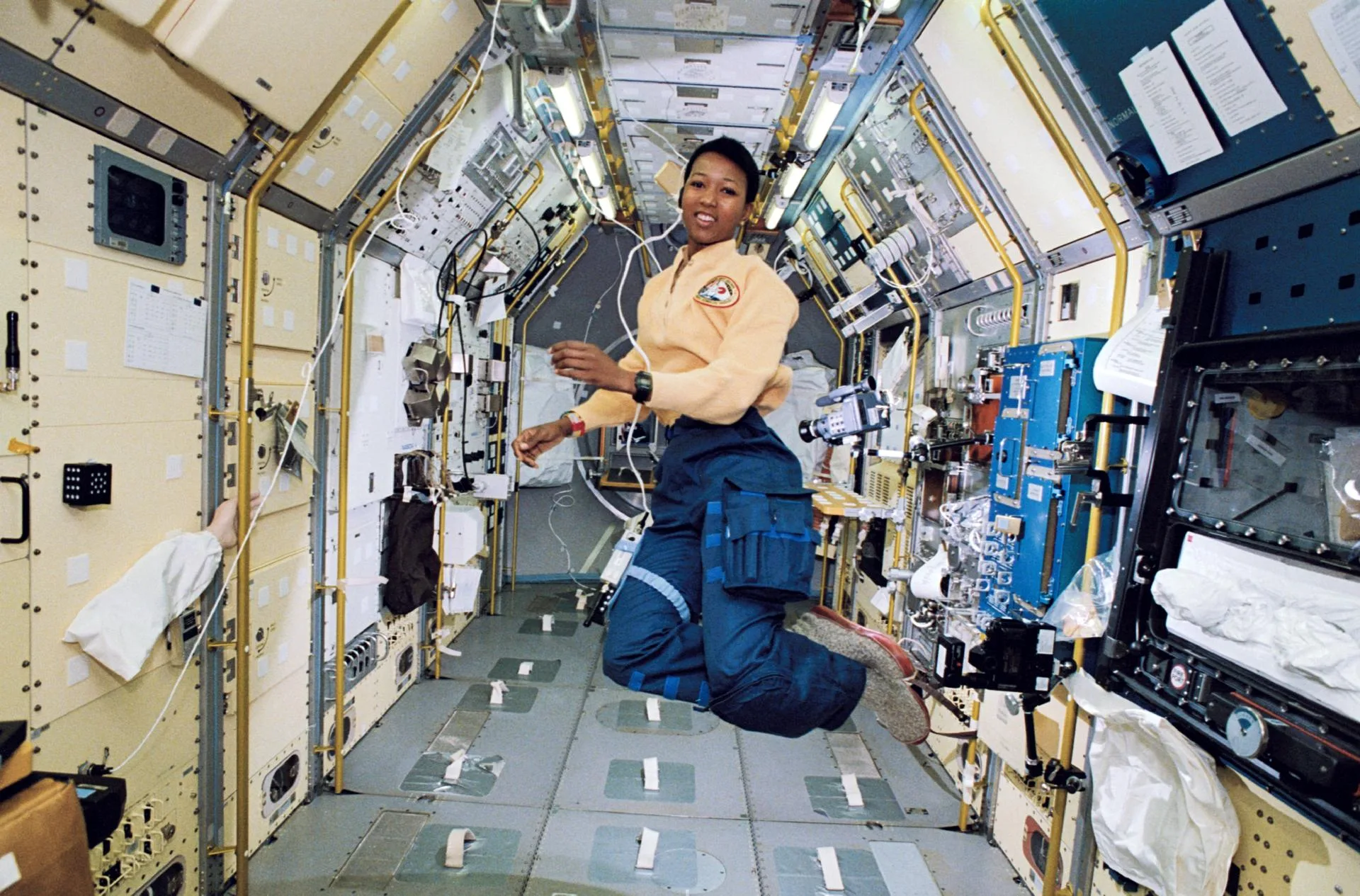
Remembering the experiments matters because the historical headline can otherwise swallow the job itself. Jemison was part of a crew conducting research in a shared working environment. The laboratory, equipment and procedures visible in the archive photographs help restore that practical detail to a story often reduced to a portrait and a date.


The flight lasted just under eight days. Its significance reached much further, particularly for people who had rarely seen someone like themselves represented in that profession. Those two scales can sit together: a specific research mission with defined tasks, and a public achievement that changed what many viewers could imagine for their own future.
The work after NASA kept education in the picture
Jemison left NASA in March 1993. Her later work included founding the technology consultancy The Jemison Group and establishing the Dorothy Jemison Foundation for Excellence. NASA’s account also describes The Earth We Share, a science-literacy programme designed around critical thinking, problem-solving and helping students develop scientific knowledge through experience.
That educational thread connects naturally with the breadth of her earlier studies. A question about technology can involve human behaviour, history, design and the conditions in which people live. Jemison’s career gives young readers a concrete example of pursuing more than one serious interest, rather than assuming that a scientific identity requires every other curiosity to disappear.
New generations have continued to see different routes into exploration. Our 2023 report on Jeremy Hansen’s lunar crew selection records another moment when a public announcement made years of preparation visible. Jemison’s birthday is an opportunity to return to the preparation behind her own achievement, too.
At 70, her story rewards that fuller view. The doctor working in West Africa, the astronaut carrying out experiments and the educator building opportunities for students are parts of the same biography. Her historic flight remains remarkable, while the surrounding work gives readers much more to learn from than a first alone.


Isiagu Tobby
Wowplus editorial contributor.