
Table of contents
James Dyson’s business wealth is easy to reduce to a large number and much harder to describe accurately. His name appears on products, in company announcements and now in another ownership story involving Bath Rugby. Those connections are real, but they do not all measure the same thing.
In results published on 26 March 2026, Dyson reported 2025 revenue of £6.13 billion, EBITDA of £1.11 billion and operating profit of £0.6 billion. These are company performance figures for a stated reporting year. They are not a published personal balance sheet for its founder.
That distinction matters whenever a successful business becomes shorthand for a person’s fortune. A reader looking at a headline should first ask what the number describes: sales over a period, earnings after specified costs, an ownership interest or an estimated value on a particular date.
The same question shaped our examination of Sara Blakely’s Spanx deal and its valuation headline. A transaction can supply valuable evidence, while still leaving a gap between the announced business value and an individual’s cash, taxes, obligations and retained interests.
Revenue and profit can move in different directions
The 2025 release compares revenue with £6.57 billion in 2024. Using those published figures, the decline is about 6.7 percent. At the same time, the company reported growth in EBITDA and operating profit. That combination illustrates why a sales headline alone cannot describe the whole year’s performance.
EBITDA means earnings before interest, taxes, depreciation and amortisation. Operating profit is a different subtotal, and neither should be casually relabelled as money paid to an owner. The label attached to a figure is part of the information, not a detail that can be dropped when retelling the story.
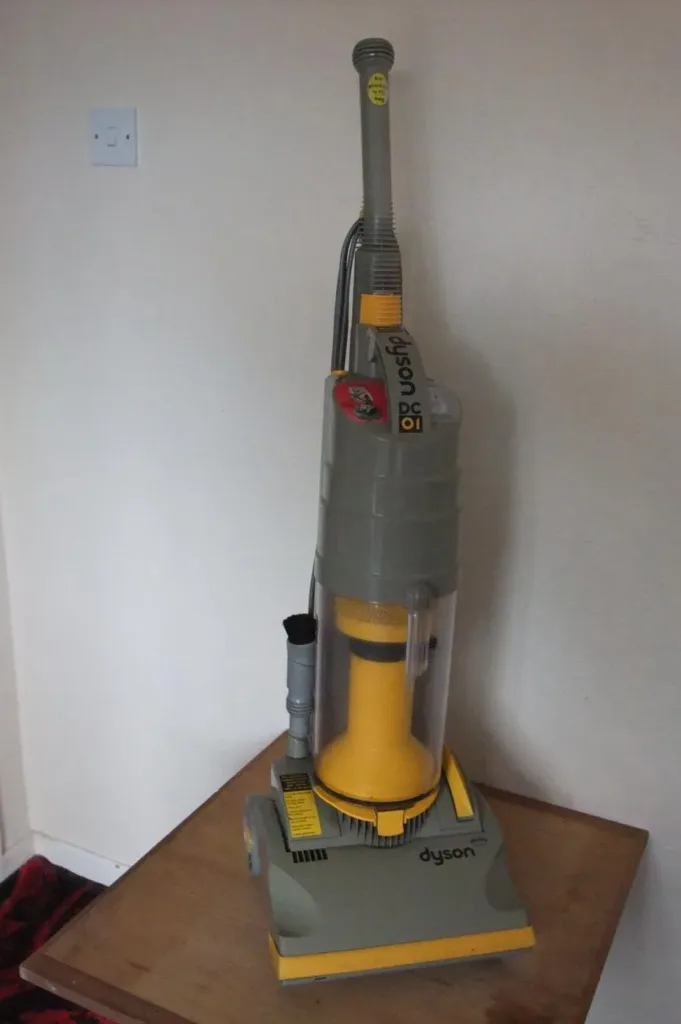
Dyson’s announcement attributes pressure to tariffs and currency movements, among other conditions. That is management’s account of its results. It provides context for the figures without proving what any single product, market or future year will contribute.
Brand businesses can require a different reading again. Our look at Martha Stewart’s Bandolier collaboration and brand business separates products and intellectual property from personal proceeds. The point in both cases is to identify the actual business activity before attaching a wealth claim to it.
The engineering story explains a different kind of value
The James Dyson Foundation traces the vacuum-cleaner idea to frustration with a clogging bag and an experiment using cyclone technology. Its account describes years of development and thousands of prototypes. That history helps explain the founder’s public identity, but a prototype count is not a valuation method.
What makes an invention story interesting is the movement from a proposed solution to something that can be produced and used. A familiar product can make that process appear inevitable in hindsight. The historical record is more useful when read as development over time, rather than as proof that every new idea must succeed.
A company’s spending on research belongs to that same distinction between current activity and hoped-for results. Money committed to development demonstrates a commitment of resources. Whether a particular project becomes commercially important is a separate question that needs its own evidence.
Bath Rugby adds another ownership interest
Bath Rugby’s 2026 announcement says James Dyson acquired a 50 percent stake in the group comprising the club, stadium-development company Arena 1865 and the Farleigh training facilities. That is a defined ownership disclosure from the club itself. It is more precise than simply saying that he bought a rugby team.

The percentage does not, by itself, disclose a transaction price or the market value of everything else he owns. It also should not be treated as an acquisition made by the consumer-products company merely because the founder and the business share a name. Keep the announced parties and assets visible.
For another example of separating a public personality from particular businesses, our examination of Snoop Dogg’s portfolio and ownership evidence follows the individual interests. A collection of recognisable associations becomes more informative when each one is described on its own terms.
A better way to read the next wealth headline
The US Securities and Exchange Commission’s introductory guide distinguishes a balance sheet’s snapshot of assets and liabilities from an income statement’s activity over a period. It also explains why profit and cash movement require separate attention. These are useful reading distinctions even when the subject is a private company.
For Dyson’s reported results, the primary document is the company’s own Dyson announcement. Keep its reporting year and original currency with the figures. A release published in 2026 about 2025 is not automatically a full account of trading during 2026.
When a headline makes a personal net-worth claim, look for the valuation date, the assets included, the ownership assumptions and the treatment of liabilities. An estimate may be useful, but repeating it without those boundaries gives an impression of precision that the underlying evidence may not support.
This profile does not assign James Dyson a new personal fortune figure. The stronger story is already in the evidence: a business with substantial reported activity, an engineering history and a separately disclosed sporting investment. Understanding what each establishes is more useful than combining unlike numbers into one dramatic total.

Isiagu Tobby
Wowplus editorial contributor.