





Table of contents
At least 452 people were killed and thousands injured after a powerful earthquake struck near the border of Iran and Iraq late Sunday.
The earthquake is the deadliest of the year, eclipsing the one that hit Mexico City in September, and was felt as far away as Turkey and Pakistan.
Around 100 of the dead are believed to be from one town in Iran’s Kermanshah province, the country’s semi-official Mehr news agency reported.
Latest developments:
Iran: 445 people confirmed dead, 7,100 injured, Iran’s Press TV has reported Monday afternoon.
Northern Iraq: 7 people dead in the semi-autonomous Kurdish region, said Rekawt Hama Rasheed, the health minister of the Kurdish Regional Government. Iraq’s health ministry added that 535 people were injured.
Rescue efforts: Authorities in Iran and Iraq have initiated rescue operations; Iran has declared three days of mourning.

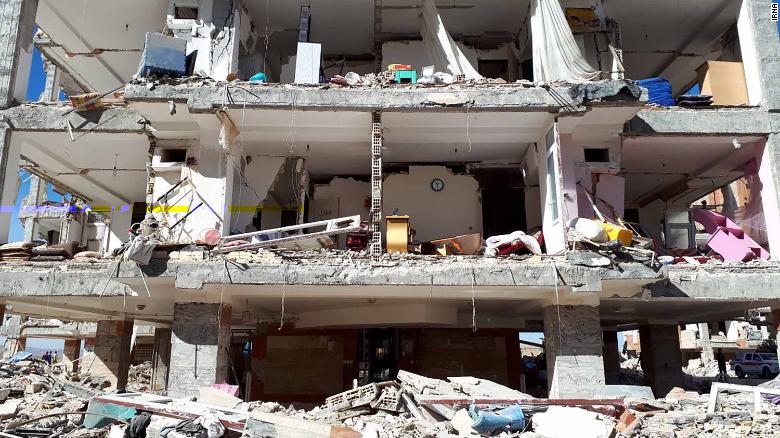
IRNA has published more photos showing the destruction the earthquake wrought on Sarpol-e Zahab, Iran.
What happened
The earthquake hit late Sunday night with the epicenter in a rural area on the Iranian side of the border, just south of the Iraqi city of Halabja, according to the US Geological Survey, which tracks earthquake activity around the world.
The quake was at a depth of 23 km (just over 14 miles), which is considered shallow, according to the survey. It was felt across the region with aftershocks hitting Pakistan, Lebanon, Kuwait and Turkey, news agencies in those countries reported.
Iraq’s Meteorological Organization issued a warning on Iraqi state TV urging citizens to stay away from buildings and to refrain from using elevators.
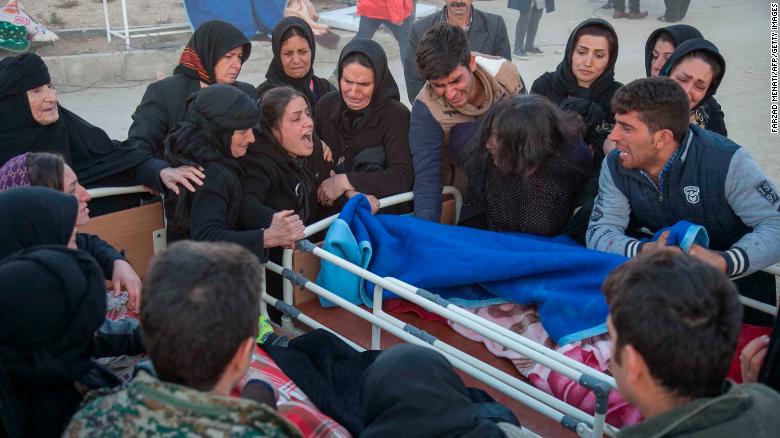
Iranians mourn over the body of a victim following a 7.3-magnitude earthquake in Sarpol-e Zahab in Iran’s western province of Kermanshah.
Iranian President Hassan Rouhani planned to travel to Kermanshah to oversee rescue work on Tuesday, Iranian state TV reported. The country’s interior and health ministers are already there to supervise the rescue operations, it said.
Iraqi Prime Minister Haider al-Abadi tweeted Monday that he “instructed civil defense teams and health and aid agencies to do all that they can to provide assistance” to those affected by the quake.
Meanwhile in Iran, the country’s Supreme Leader Ayatollah Ali Khamenei sent a message of condolence and urged military and civilian help to be dispatched to quake victims.
Iran’s Revolutionary Guard was reportedly traveling to the affected areas to help with rescue efforts, according to Iran’s semi-official Tasnim news agency.
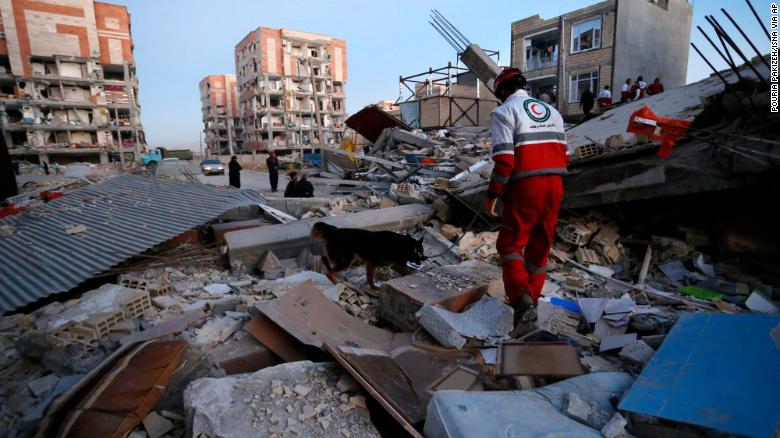
The Iranian Red Crescent Society was working in the hard-hit areas Monday with sniffer dogs, debris-removal teams, and teams offering emergency shelter and treatment, said Mansoureh Bagheri, a spokeswoman for the Iranian Red Crescent in Tehran.
More than 500 villages in the region suffered damage, Bagheri told CNN.
In Iraq’s semi-autonomous Kurdish region, four people were killed in Darbandikhan, where a dam was hit by falling rocks. Rahman Shikhani, the head of the Darbandikhan Dam, told CNN that cracks were spotted in the upper part of the structure but there was no water leakage.
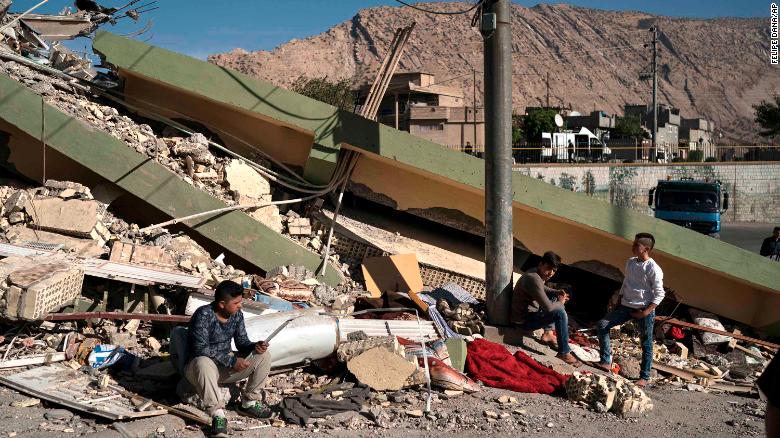
People sit on the rubble of a destroyed house after an earthquake in the city of Darbandikhan, northern Iraq.
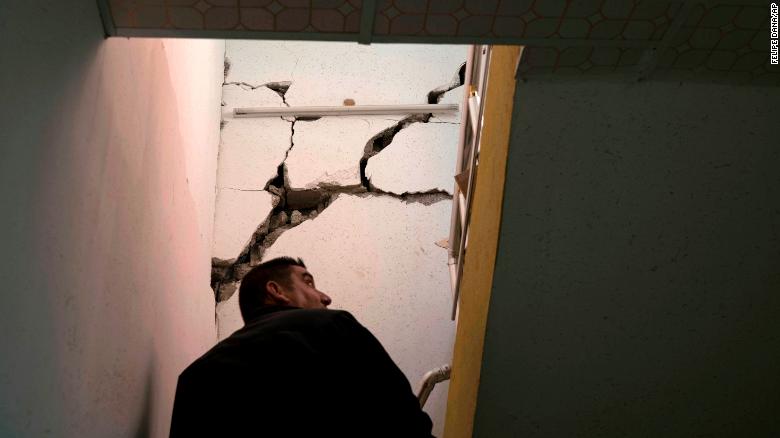
A man checks the interior of a damaged house after an earthquake in the city of Darbandikhan.
Meanwhile hundreds of people were injured in the region, though most of these were minor injuries, said Rasheed, the health minister.
What eyewitnesses saw
Majida Ameer, who lives in the south of Baghdad, said she ran to the streets with her three children after the quake hit late Sunday.
“I was sitting with my kids having dinner and suddenly the building was just dancing in the air,” Ameer told Reuters.
“I thought at first that it was a huge bomb. But then I heard everyone around me screaming: ‘Earthquake!'”
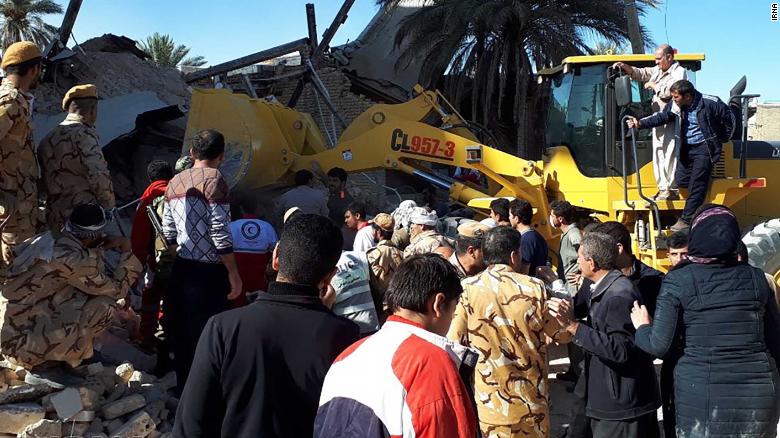
State media outlet IRNA publishes photos showing earthquake destruction in Kermanshah Province.
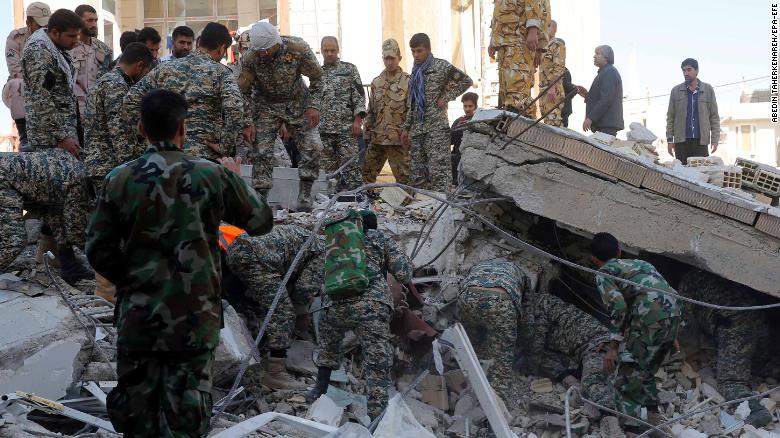
Iranian rescuers search the wreckage of a building in the city of Pole-Zahab in Kermanshah Province, Iran.
Pourya Badrkhani, a music teacher in Kermanshah, Iran, told CNN he was sitting at home watching television when the quake hit.
Badrkhani said he rushed out of his home along with his family and joined neighbors on the streets.
He said people were donating blood to help the injured while others have volunteered to go and help the border cities, which he says were the worst affected.
Previous earthquakes
Iran sits on a major fault line between the Arabian and Eurasian plates and has experienced a number of earthquakes in the past.
The deadliest this century occurred in 2003 when a magnitude 6.6 earthquake struck the southeastern city of Bam, killing some 26,000 people.

Photos: Earthquake rocks border area between Iraq, Iran
A crushed car is seen among the debris in Sarpol-e-Zahab on November 13.
Hide Caption
11 of 20
Photos: Earthquake rocks border area between Iraq, Iran
Two earthquake survivors embrace at the site of a collapsed building in Iraq’s Darbandikhan district.
Hide Caption
12 of 20
Photos: Earthquake rocks border area between Iraq, Iran
The aftermath of the quake in Sarpol-e Zahab.
Hide Caption
13 of 20
Photos: Earthquake rocks border area between Iraq, Iran
Residents of Sarpol-e Zahab huddle by a fire after the earthquake.
Hide Caption
14 of 20
Photos: Earthquake rocks border area between Iraq, Iran
Rescue crews search through the rubble in Sarpol-e Zahab on November 13.
Hide Caption
15 of 20
Photos: Earthquake rocks border area between Iraq, Iran
A man searches for people trapped in the rubble in Iraq’s Darbandikhan district on Sunday, November 12.
Hide Caption
16 of 20
Photos: Earthquake rocks border area between Iraq, Iran
A man searches the rubble for survivors in Iraq’s Darbandikhan district.
Hide Caption
17 of 20
Photos: Earthquake rocks border area between Iraq, Iran
A wounded person is rushed to a hospital in Iraq’s Sulaimaniya province on November 12.
Hide Caption
18 of 20
Photos: Earthquake rocks border area between Iraq, Iran
People in Sulaimaniya search for people trapped in rubble on November 12.
Hide Caption
19 of 20
Photos: Earthquake rocks border area between Iraq, Iran
Iraqis search for trapped citizens on November 12.
Hide Caption
20 of 20
Photos: Earthquake rocks border area between Iraq, Iran
A rescue worker and his sniffer dog search for earthquake survivors in Sarpol-e-Zahab, Iran, on Monday, November 13. It was the day after a 7.3 magnitude earthquake struck the border region between Iran and Iraq. Hundreds were killed and thousands were hurt, officials said.
Over a decade earlier, in June 1990, an estimated 37,000 people were killed and the northern cities of Rudbar, Manjil, and Lushan were destroyed along with hundreds of villages.
In 2005, a 6.4 magnitude earthquake rocked the city of Zarand in the southeastern province of Kerman, killing at least 400 people, and in 2012 a pair of earthquakes jolted northwest Iran, killing at least 300 people.


Terry Paul
Paul Terry is a publisher and an author in wowplus.net and other news channel