




Table of contents
- Amazon warehouse workers raise concerns about coronavirus spread
- Wikimedia’s approach to coronavirus: Staffers can work 20 hours a week, get paid for full time
- Marriott International, Compass Coffee announce sweeping layoffs
- White House signals support for sending checks to Americans in ‘next two weeks’ to address coronavirus
- Lyft joins Uber in suspending its shared rides
- Federal Reserve launches special fund to keep credit flowing in U.S. economy during coronavirus scare
- Perspective: What to expect now that we’re talking bailouts
- United Healthcare tells employees to report for work unless they are in high-risk category
- Businesses were already hurting under Trump’s trade war. Then came coronavirus.
- Trump administration seeks $850 billion in emergency stimulus to confront coronavirus economic fallout
- Nordstrom shutters all stores for 2 weeks, withdraws financial outlook
- Despite recent stoppages, experts say markets will remain open

White House outline coronavirus countermeasures, Live updates: Wall Street gets second wind after Fed, . Treasury Secretary Steven Mnuchin also told reporters that the White House was looking at giving direct cash payments to Americans as part of a massive economic stimulus package of around $850 billion, which the White House hopes could stanch the economic free fall caused by the coronavirus. President Trump had initially supported a payroll tax holiday, but said Tuesday that would take too long to deliver relief to Americans.
“We’re looking at sending checks to Americans immediately,” Mnuchin said Tuesday at a briefing. “And I mean, now in the next two weeks.”
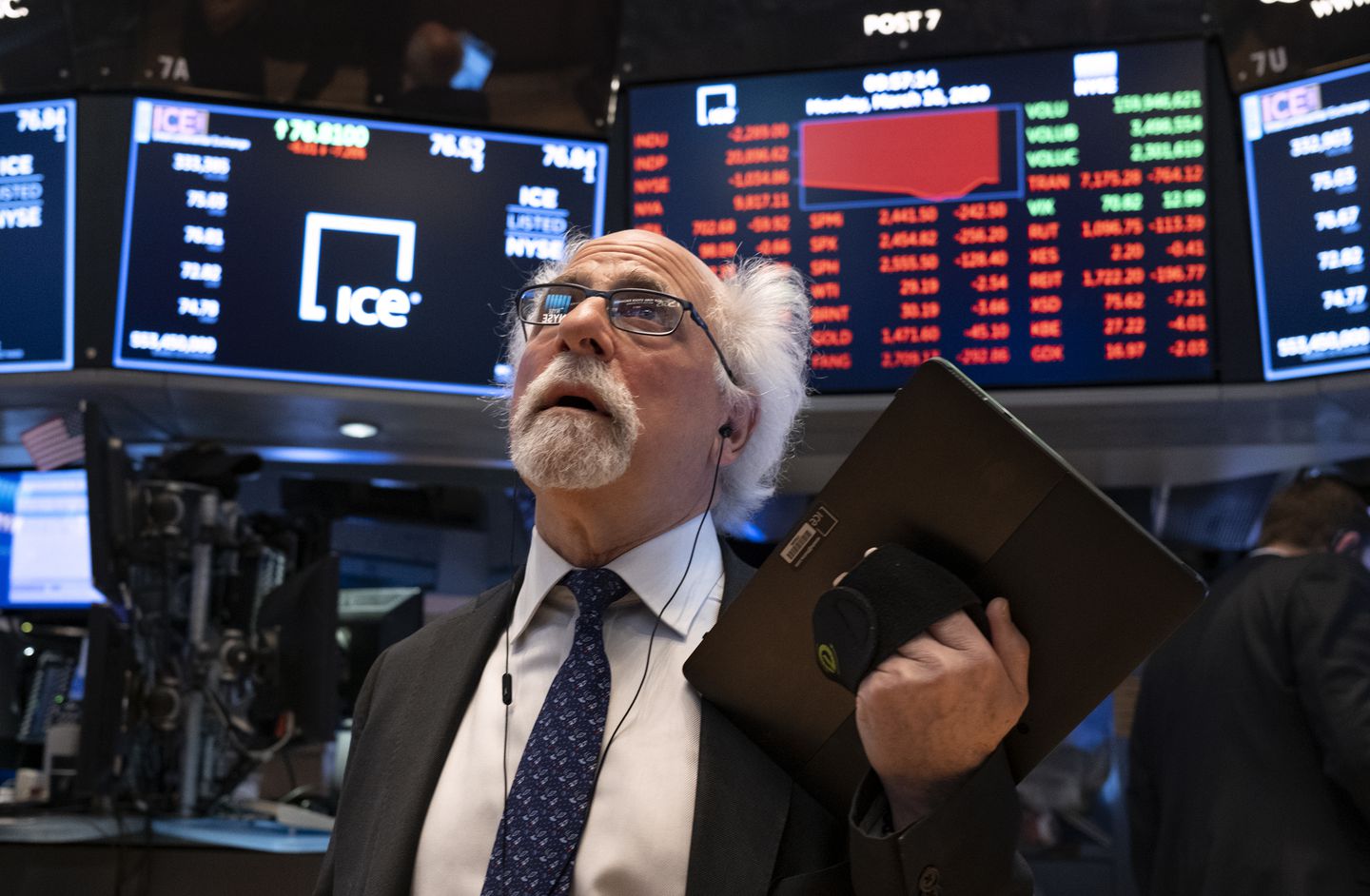
The news delivered a much-needed jolt to U.S. markets, which had been oscillating wildly between positive and negative territory on the heels of their worst day of trading since the 1987 “Black Monday” crash. Around 1, the Dow was up more than 500 points, or 2.7 percent. The Standard & Poor’s 500 index climbed 4.1 percent, and the tech-heavy Nasdaq jumped 4.2 percent.
Volatility has reigned as investors struggle to parse the coronavirus’ increasingly disruptive presence in the United States and the growing threat of a recession. The highly-watched Cboe Volatility Index, Wall Street’s “fear gauge,” saw its highest-ever close Monday after the Dow plunged 3,000 points. The new high eclipsed the one set during the financial crisis.
“This is unlike anything we have ever seen,” said Jeffrey Kleintop, chief global investment strategist at Charles Schwab. “The impact this is having, not only on energy markets, but financial services, the travel industry and people’s everyday lives is really immeasurable.”
Monday’s rout came after the Federal Reserve slashed interest rates to zero and said it would revive “quantitative easing,” a remnant of the financial crisis. Last-minute losses came after President Trump warned that disruption from the coronavirus pandemic could last through August and issued new public health guidance, saying Americans should limit gatherings to no more than 10 people.
March 17, 2020 at 1:58 PM EDT
Amazon warehouse workers raise concerns about coronavirus spread
As Amazon sales surge from shoppers stocking up on consumer staples, the e-commerce giant’s warehouse workers are raising alarms that the company is not doing enough to protect them from the novel coronavirus.
Warehouse workers in Spain and Italy have tested positive for the virus, while workers in New York and Chicago told The Washington Post that Amazon isn’t taking enough precautions as orders mount. Some said workers were sent home only after they had coughs, and signs were posted advising workers to wash their hands.
But in interviews, warehouse workers in the United States and Europe say they worry their workplaces aren’t safe enough and could contribute to the spread of the virus. More than 1,500 workers from around the world have signed a petition that calls on the company to take additional steps to ensure the safety in their workplace.
Amazon says it’s taking appropriate precautions to protect workers. The company says it’s following guidance from health officials regarding the operation of its facilities. (Amazon founder Jeff Bezos owns The Washington Post.)
By Jay Greene and Elizabeth Dwoskin
March 17, 2020 at 1:46 PM EDT
Wikimedia’s approach to coronavirus: Staffers can work 20 hours a week, get paid for full time
As employees across the country juggle remote work and child care, the nonprofit that operates Wikimedia has told workers they can work just 20 hours a week and continue to receive full-time pay.
In a letter to employees, Katherine Maher, chief executive of the Wikimedia Foundation, said: “We’re not declaring a holiday — if you are able to work more normal hours, the mission can use you. However, the world is unpredictable right now, and whether you need to care for loved ones, get groceries, or go to the doctor, your well-being is our priority. We are not tracking your time.”
Maher said the decision was made to give the foundation’s 400 employees and contractors a realistic sense of what’s expected. “We wanted to give them clear guardrails,” she said in an interview Monday evening.
When employers give generic instructions telling employees to juggle their increased workload however they can, she said, “it just creates an uncertainty and lack of clarity as [employees] try to read between the lines about what’s expected.” By creating a “ceiling” of hours, she hopes workers are able to shift to home responsibilities and think “the organization’s not going to judge me.”
By Jena McGregor
March 17, 2020 at 1:44 PM EDT
Marriott International, Compass Coffee announce sweeping layoffs
Marriott International, the world’s largest hotel brand, has begun furloughs affecting tens of thousands of employees as a global pandemic wears on large segments of the economy.
The news was first reported by the Wall Street Journal and confirmed by The Post on Tuesday. The hotel chain with nearly 1.4 million rooms started shutting down properties last week.
Furloughed employees won’t be paid but a large share of them will still receive health-care benefits. The cuts have hit general managers and housekeepers alike. Marriott has about 130,000 employees in the United States.
“We are adjusting global operations accordingly which has meant either reduction in hours or a temporary leave for many of our associates at our properties,” a company statement read. “Our associates will keep their health benefits during this difficult period and continue to be eligible for company-paid free short-term disability that provides income protection should they get sick.”
Along with air travel, hotel occupancy has plunged as governments roll out more measures to keep people close to home and away from crowds to blunt the spread of coronavirus. In a news release Tuesday, the American Hotel and Lodging Association said that the hotel industry is losing $1.4 billion in revenue each week. Current estimates show that roughly one million direct hotel jobs, or 45 percent of all hotel jobs, have either been eliminated or will be eliminated in the next few weeks. Forecasts for a 30 percent drop in hotel occupancy over a full year would result in nearly 4 million total jobs lost, AHLA said.
Also on Tuesday, Washington, D.C.-based Compass Coffee, laid off 180 of its 200 employees, according to local reporter Jason Shevrin. A company announcement shared online said that the company laid off “the vast majority of our baristas” so they are eligible for unemployment benefits. Compass Coffee did not immediately respond to a request for comment.
“As a small business, after struggling for two weeks and coming up with projects to keep people employed, we simply ran out of work, and could not afford to pay people without things for them to do,” the company said.
By Rachel Siegel
March 17, 2020 at 12:54 PM EDT
White House signals support for sending checks to Americans in ‘next two weeks’ to address coronavirus
The Trump administration expressed support on Tuesday for sending direct cash payments to Americans as part of a massive economic stimulus package of around $850 billion, which the White House hopes could stanch the economic free fall caused by the coronavirus.
“We’re looking at sending checks to Americans immediately,” Treasury Secretary Steve Mnuchin said Tuesday at a briefing. “And I mean, now in the next two weeks.”
The White House’s support of this idea, which has won backing from Democrats and some Republicans in Congress, shows how fast talks are evolving. President Trump had initially supported a payroll tax holiday, but said Tuesday that would take too long to deliver relief to Americans.
By Erica Werner and Jeff Stein
March 17, 2020 at 12:39 PM EDT
Lyft joins Uber in suspending its shared rides
Lyft paused its shared rides Tuesday, joining rival Uber in suspending pooled trips in an effort to limit personal interactions during the coronavirus outbreak.
The action comes hours after Uber suspended its Pool option, following a White House directive urging people not to gather in groups of 10 of more. Officials are urging “social distancing,” including remaining at least six feet away from others, as a way to limit the spread of the virus amid the outbreak.
1) Our goal @Uber is to help flatten the curve of community spread in the cities we serve. With that in mind, we are suspending our Pool option in the US and Canada. 18 cities in all, including SF, NYC and Seattle.
— Andrew Macdonald (@andrewgordonmac) March 17, 2020
Lyft spokeswoman Alexandra LaManna said the decision was made for the safety of passengers.“ The health and safety of the Lyft community is our top priority, and we’re dedicated to doing what we can to slow the spread of COVID-19,” LaManna said. “We will continue to monitor the situation closely and base our actions on official guidance.”
By Faiz Siddiqui
March 17, 2020 at 11:47 AM EDT
Federal Reserve launches special fund to keep credit flowing in U.S. economy during coronavirus scare
The Federal Reserve is launching a special fund to keep credit flowing in the U.S. economy, yet another emergency measure as the world spirals toward a recession.
Starting Tuesday, the central bank will buy significant amounts of commercial paper, the short-term loans that businesses rely on for funding to pay bills and other expenses. The Fed did the same thing during the Great Recession and ended up buying about $350 billion worth of these loans, or about 20 percent of this market.
Buying this debt helps ensure there is a financial lifeline for businesses and households to make it through this crisis. The commercial paper market directly impacts the mortgage and auto loan markets in addition to credit for small and large businesses.
“By ensuring the smooth functioning of this market, particularly in times of strain, the Federal Reserve is providing credit that will support families, businesses, and jobs across the economy,” the central bank said in a statement.
Wall Street investors and economists have been calling for the central bank to do this as the commercial paper market has nearly frozen in recent days. The action is known formally as a “Commercial Paper Funding Facility,” and it helps prevent short-term cash crunches.
By Heather Long
March 17, 2020 at 10:48 AM EDT
Perspective: What to expect now that we’re talking bailouts
This week you can expect to hear warnings from business groups about the jobs that will be lost, the bankruptcies that will be triggered, the financial panic that will ensue and the recession that will be prolonged if the government fails to act quickly and aggressively.
And there will be the predictable rants about putting taxpayers on the hook for “bailing out” undeserving shareholders, banks and hedge fund managers even as waiters, taxi drivers and maids are left to fend for themselves.
Democrats will accuse Republicans of groveling to Wall Street and business interests while Republicans will accuse Democrats of groveling to unions and wanting to pick winners and losers. In the end, a rescue package with a price tag of hundreds of billions of dollars will be narrowly approved by both houses of Congress over the opposition of partisans and ideological purists in both parties.
To learn more about the political melodrama that’s about to unfold, read here.
By Steven Pearlstein
March 17, 2020 at 9:52 AM EDT
United Healthcare tells employees to report for work unless they are in high-risk category
As a growing number of companies have adopted broad work-from-home policies, UnitedHealth Group is telling employees to go to work unless they are part of a high-risk group, experiencing any symptoms, or face certain other obstacles.
The guidelines, shared in emails Sunday to its 325,000 employees and managers, says employees are “expected to come to their assigned work location unless they have self-identified as being at higher risk for serious COVID-19 illness or are experiencing symptoms of respiratory infection, such as cough, fever or runny nose.”
In the email to employees, UnitedHealth’s chief human resources officer, Patricia Lewis, wrote that “while other less essential industries have implemented broad work-from-home policies, we are a health-care company, and our business needs to operate as smoothly as possible during this health crisis to serve others.”
By Jena McGregor
March 17, 2020 at 9:50 AM EDT
Businesses were already hurting under Trump’s trade war. Then came coronavirus.
Jay Foreman laid off a dozen workers late last year as his company, Basic Fun! Toys, stared down a round of China tariffs that were supposed to take effect in mid-December.
But he got a reprieve when President Trump announced a “phase one” agreement with Beijing. But Foreman remained on guard, knowing that any rupture in the trade deal — or in the broader economy — could trigger a sudden blow.
Then came coronavirus. At first, Foreman worried about a supply chain backlog as Chinese factories ground to a halt. Then, once manufacturing started coming back online, the U.S. economy went into free fall, and Foreman isn’t sure whether his customers will keep their orders. A week and a half ago, he laid off 18 people.
Given the outbreak’s shock factor, inconsistent government response and economic calamity, Foreman summed up his situation bluntly: “This is like 9/11, Katrina and the financial crisis all condensed into one.”
By Rachel Siegel
March 17, 2020 at 8:33 AM EDT
Trump administration seeks $850 billion in emergency stimulus to confront coronavirus economic fallout
The Trump administration is asking Congress to approve a roughly $850 billion economic stimulus package to stanch the economic free-fall caused by the coronavirus, four officials familiar with the planning said Tuesday.
Treasury Secretary Steven Mnuchin will present the details to Senate Republicans later Tuesday. The package would be mostly devoted to flooding the economy with cash, through a payroll tax cut or other mechanism, two of the officials said, with some $50 billion directed specifically to the airline industry. The officials spoke on the condition of anonymity to discuss internal deliberations.
Mnuchin would like to see the package pass the Senate by the end of the week, he told senators Monday evening in a meeting at the Capitol.
“I think the assumption’s going to be that we’re going to do something, it should be big. Because we can’t assume that we’re just going to keep coming back,” Sen. Marco Rubio (R-Fla.) said Monday night leaving a meeting with Mnuchin and other administration officials.
By Erica Werner and Jeff Stein
March 17, 2020 at 8:25 AM EDT
Nordstrom shutters all stores for 2 weeks, withdraws financial outlook
Nordstrom joined a growing list of retailers closing their doors and said it would withdraw its 2020 financial outlook as shoppers stay home and governments restrict commercial activity to contain the spread of coronavirus.
Starting Tuesday, all 116 Nordstrom stores in the United States, Canada and Puerto Rico, and 248 Nordstrom Rack locations will close for two weeks. The Seattle-based department store chain said it will provide pay and benefits during this period, and that its online business — which made up a third of its 2019 sales — will continue operating.
Though February sales met expectations, Nordstrom said that it has “experienced a broad-based deceleration in customer demand over the past couple of weeks, particularly in markets most affected by the virus.”
“During this unprecedented period of uncertainty, we have in place the appropriate business continuity plans, operational framework and team,” said CEO Erik Nordstrom. “This, in concert with ending 2019 with a solid financial position and healthy balance sheet, gives us the ability to weather this challenging moment in time.” Company shares are down 60 percent in the past year.
Nike, Apple and Urban Outfitters are among the retailers that have suspended their brick and mortar operations. The closures come as an increasing number of states are imposing sharp restrictions on retail, restaurants, bars and casinos to limit crowds and keep people at home. And with many retail stores already facing razor thing margins, it’s unclear how long the industry and its workers can hang on.
In a Tuesday analyst note, Cowen’s Oliver Chen wrote that he expects “broad store and mall closures” to adhere to social distancing policies. Chen wrote that even though online sites are still an option, store closures deal a blow to financial results and “compound stress in an already declining traffic environment for mall retailers.” Moreover, if the outbreak extends beyond the first quarter, apparel companies that source from China could risk not receiving new products ahead of the summer and fall seasons, Chen wrote.
By Rachel Siegel
March 17, 2020 at 8:03 AM EDT
Despite recent stoppages, experts say markets will remain open
The New York Stock Exchange has activated what’s known as a “circuit breaker” three times in the past two weeks to allow investors to take a 15-minute breather from furious trading. That raises the question of whether trading should be suspended altogether given the beatings the Standard & Poor’s 500 index and Dow Jones industrial average have suffered in recent weeks amid the coronavirus outbreak.
“The underlying causes of the sell-off would not change if we just stopped trading,” Cunningham told CNBC on Monday. “The market is a really good indicator of what investor sentiment is, so it’s helpful to have that there.”
Christopher Detmer, managing director of the Washington Wealth Group, said there would need to be a “more catastrophic public health concern,” to warrant closing the stock exchanges. “Price discovery is going to happen eventually, better not to have it happen all at once after a prolonged period of being closed.”
Cunningham said that even if the NYSE were to shut down, investors would find other places to trade. Terry Duffy, chief of Chicago-based CME Group, a global markets trading firm, and Tal Cohen, head of North American Market Services at Nasdaq, agreed.
“You should at least leave the markets open, so people can transact,” Duffy told CNBC.
By Thomas Heath


Terry Paul
Paul Terry is a publisher and an author in wowplus.net and other news channel