











-

Liam James Doyle/NPR
-

Liam James Doyle/NPR
-

Liam James Doyle/NPR
-

Liam James Doyle/NPR
-

Liam James Doyle/NPR
-

Liam James Doyle/NPR
-

Liam James Doyle/NPR
-

Liam James Doyle/NPR
-

Liam James Doyle/NPR
Pride parades are known for glitter, upbeat music and happy people dancing on bright floats, as they make their way through loud, colorful crowds.
This was not a pride parade.
“Stonewall began as a riot,” Sian Lewis, a member of the D.C. planning committee for the Equality March, said, as “YMCA” by the Village People blared from large, black speakers behind her.
“We are living the legacy of Stonewall,” she said.
Crowds stretched for blocks across the parade route near the National Mall, and while Lewis said they anticipated more than 200,000 marchers, she said the number of people who showed up blew their expectations.
Lesbian, gay, bisexual, transgender, queer, straight, white, black, Latinx Americans and people from across the world all marched in solidarity today to protest the excess of the Trump administration and how they believe it could negatively affect the LGBT community.
Participants were all ages. And they came from all over the world, on two feet or more.
One group of softball-playing best friends from Tampa, Fla., arrived with lettered signs that spelled out RESISTANCE. They all wore top hats as a tribute to their friend, Top Hat Eddie, who was killed one year ago in the Pulse shooting that rocked the LGBT community.
They said part of the reason they came out was in remembrance of their friend and to make sure nothing like that happens again. That starts, they say, with resisting the Trump administration.
“It’s very important to express the importance of how far we’ve come,” said 46-year-old Anthony Micheletti from Chicago. “I will not allow them to take [my rights] away. You’ll have to drag me in heels.”
The political march for equality comes one day after the Pride Parade in D.C., while marches and protests are ongoing around the country this June for Pride month.
And many participants feel as if this time in history is a turning point for the LGBT movement. They see it as an opportunity to note that while LGBT rights increased over the past decade, there’s still a long way to go.

Sh’mon Jackson, a drag queen from New York. Liam James Doyle/NPR hide caption
toggle caption
Liam James Doyle/NPR
Sh’mon Jackson, a drag queen from New York.
Liam James Doyle/NPR
“The parade yesterday was fun, but today we’re fighting for our rights,” Sh’mon Jackson said. She’s a drag queen from New York who traveled to the nation’s capital for this weekend’s festivities.
“You have whatever you want,” she said of the politicization of pride. She said if you want to get political, you can come to this march. If not, “across the block there’s a party. You can make [Pride] what you want.”
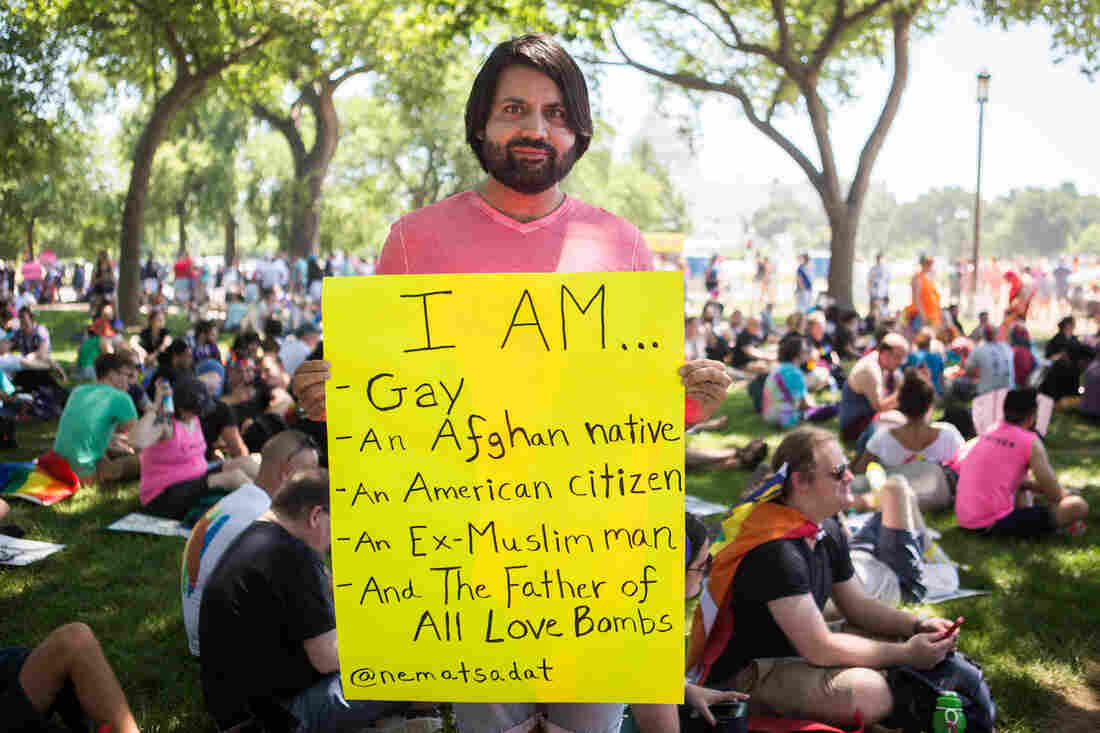
Nemat Sadat, originally from Afghanistan, now lives in Washington, D.C. Liam James Doyle/NPR hide caption
toggle caption
Liam James Doyle/NPR
Nemat Sadat, originally from Afghanistan, now lives in Washington, D.C.
Liam James Doyle/NPR
Nemat Sadat wandered around the mall after the Equality March with a sign proclaiming his identities: immigrant, gay, creator.
“Since Stonewall, this is a continuation and expansion,” Sadat said. “Today, we’re here to fight against the Trump administration.”
In particular, Sadat said, they were there to advocate against how the Trump administration has accepted human rights violations against the LGBT community in across the world, like his home country of Afghanistan.

Estrellia Sanchez, a transgender woman from Atlanta. Liam James Doyle/NPR hide caption
toggle caption
Liam James Doyle/NPR
Estrellia Sanchez, a transgender woman from Atlanta.
Liam James Doyle/NPR
Estrellia Sanchez, a transgender woman from Atlanta who was born and raised in Mexico, said she attended the march to fight on multiple fronts through her passions for immigration reform, prison reform and transgender rights.
“I want equity for my community who are incarcerated,” she said. “I am human.”
Sanchez is one of many who traveled far for this march.
“We came here to show that all corners of the country are united,” said John Dyrcz, a 32-year-old man who traveled to D.C. from New Mexico with friends Chris Heise, Jason Anderson and Jesus Gallegos. They all identify as gay men.
Dyrcz said they’re glad the politicization of the movement is becoming stronger again.
“To make [the movement] political, makes it visible.”

Reg Franchi, a transgender gay man from Los Angeles, Calif. Liam James Doyle/NPR hide caption
toggle caption
Liam James Doyle/NPR
Reg Franchi, a transgender gay man from Los Angeles, Calif.
Liam James Doyle/NPR
Reg Franchi, a transgender gay man, traveled from Los Angeles, which is having a resist march in place of its annual pride parade this year, where they’ve traded the typical pride floats for a march for civil rights for LGBT people.
Franchi echoed the feelings of the rest of the marchers in D.C. and back home. He said he’s ready for pride to get back to being political.
“The very first march was in memory of Stonewall,” he said. “So it’s going back to our roots.”

Dustin Moore, 31, marched in D.C. to express his discontent with the current administration. Liam James Doyle/NPR hide caption
toggle caption
Liam James Doyle/NPR
Dustin Moore, 31, marched in D.C. to express his discontent with the current administration.
Liam James Doyle/NPR
Dustin Moore is a 31-year-old gay man who says he understands why the movement has always been so political, but that LGBT people never actually asked for its politicization. Many members of the LGBT community, Moore included, feel that their identity has been co-opted into a political movement without their consent.
“It’s not our decision to politicize it,” he said. “Treating it like it’s not a political arena does us no good.”
The entire month of June has historically been dedicated as Pride month, with celebrations all month across the country. For the first time in years, the U.S. President did not identify the month publicly, and the lack of action by President Trump did not go unnoticed by the LGBT community and their allies.
Despite that, Pride month will continue with events around the world for people to stand in solidarity with the LGBT community.
Nemat Sadat says he’s looking forward to all the progress that’s left to be made.
“We have to be the beacons of hope and light in this world.”








Leave a comment