Table of contents
Voyager 1 has reached a distance that turns a routine exchange with Earth into a wait of roughly two days. The spacecraft crossed the one-light-day mark on November 18, 2026, after more than 49 years of travel. The record arrives alongside an unresolved engineering problem: its radio carrier is reaching Earth, while its usual science and engineering data are missing.
In its November 19 announcement, NASA said the milestone occurred at about 10:16 UTC on November 18, or 11:16 a.m. in Nigeria. Engineers confirmed it using the carrier signal and trajectory calculations. The agency said it had received no science or engineering data since November 14.
Distance has always shaped robotic exploration, as our 2021 preview of Perseverance’s Mars landing illustrated through the planning required for a distant spacecraft. Voyager now makes that separation especially tangible. Even a perfectly transmitted instruction cannot reach its destination on the same day it leaves Earth.
What one light-day means for Voyager 1
A light-day measures distance: about 25.9 billion kilometres, the distance light travels in 24 hours. NASA’s explainer notes that radio waves travel at that same speed through space. Voyager took decades to cover a distance that a radio transmission crosses in a day.
Consider an idealised timing example. A command sent at noon on Monday would arrive around noon on Tuesday. If the spacecraft immediately transmitted a response, that response would reach Earth around noon on Wednesday. This illustration counts only travel time, before any delay for execution, antenna scheduling or analysis.
The distinction matters when reading a troubleshooting update. Two days is an approximate minimum for that exchange, not a promised time for an answer. A carefully planned sequence can require several exchanges. The team has to work with information that describes an earlier state of the spacecraft.
A carrier signal provides a limited but useful clue
NASA’s November 18 engineering update described a Canberra antenna receiving a carrier without the expected data on November 14. The agency said the signal indicates that the spacecraft’s pointing-control computer, antenna and broadcasting equipment are still performing their roles.
The missing information suggests a problem in the computer that collects and formats data for transmission, according to that update. This remains an indication under investigation. It does not establish a final diagnosis, identify a repair or show that normal science operations have resumed.
NASA cautioned that diagnosis could take weeks or longer. Engineers are considering whether the November issue connects with a separate October interruption, and drawing on experience with a 2023 problem. Those earlier events provide useful experience, but they do not establish that the current fault has the same cause.
Our 2022 report on the evidence for ice volcanoes on Pluto offers another reminder of the value of spacecraft observations. A distant mission becomes useful to researchers through information they can examine. Hearing a carrier and receiving interpretable measurements answer different questions.
The Earth stations solve a different problem
NASA’s Deep Space Network uses facilities near Goldstone in California, Madrid in Spain and Canberra in Australia. Its giant radio antennas help send commands, receive information and track spacecraft. These are the ground systems behind the connection with distant missions.
The sites are spread around the planet so another facility can pick up a spacecraft as Earth rotates and it moves below the horizon of one station. Each complex includes a 70-metre antenna. Geographic coverage helps maintain opportunities for contact, although it does not mean Voyager has uninterrupted use of the network.

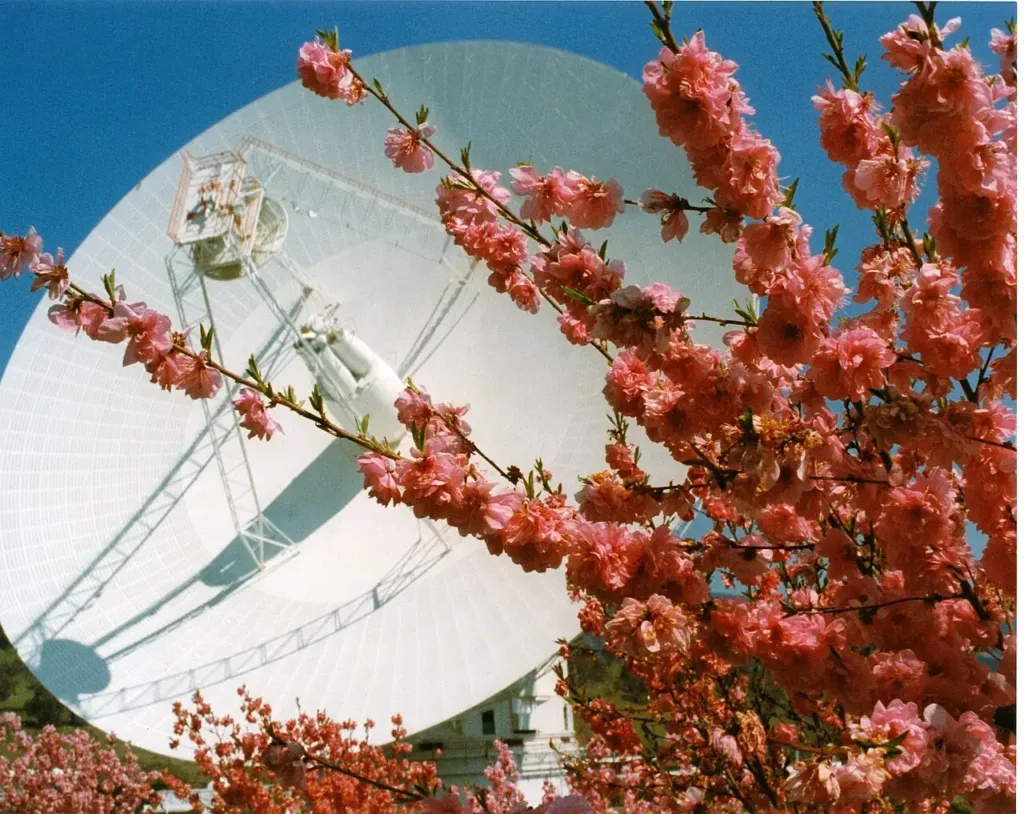
That arrangement addresses visibility from Earth. It cannot shorten the distance a radio wave has to cross. The distinction is useful: having a station available, detecting a signal and receiving usable data are separate parts of the communications chain. Success at one stage does not automatically settle the others.
Power and temperature add their own constraints
In an October 29 update, NASA described a September operation that replaced three powered devices with lower-power alternatives. The coordinated change also had to preserve the distribution of heat aboard Voyager 1. Conserving electricity on an ageing spacecraft involves keeping essential equipment warm enough to work.
The Voyagers use radioisotope thermoelectric generators, which turn heat from decaying plutonium into electricity. NASA reports that available power falls by about four watts each year. That gradual reduction creates a continuing need to manage which systems remain on and how the remaining energy is used.

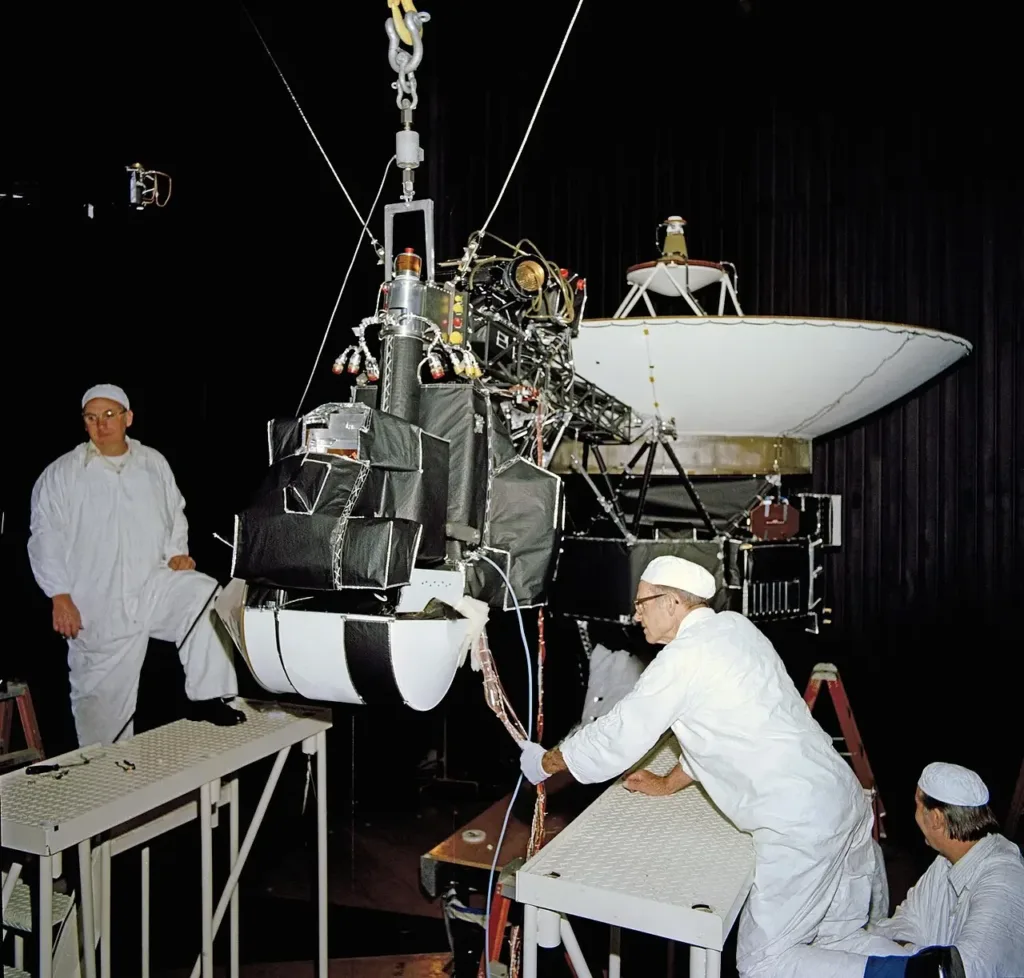
The October report also described a loss of contact that resolved on October 20, before troubleshooting commands were sent. That recovery belongs to October’s timeline. For the November problem, the dated November updates remain the relevant status reports. NASA also explained that crossing the light-day distance creates no physical change aboard the probe.
The mission’s scientific and human records travel together
Voyager 1 entered interstellar space in 2012, with Voyager 2 following in 2018. NASA’s mission overview describes their work beyond the heliosphere, the Sun’s surrounding bubble of particles and magnetic fields. The new distance record therefore marks another stage of travel; the transition into interstellar space happened years earlier.
Each probe also carries a Golden Record containing selected sounds and images of Earth. NASA’s music list includes Chuck Berry’s Johnny B. Goode, a connection explored in our Chuck Berry centenary feature. That physical cultural record travels with the spacecraft independently of its radio conversations with engineers.
The scientific mission is more immediate. Its purpose includes studying magnetic fields, particles and plasma waves beyond the heliosphere. That gives the effort to recover useful data a concrete objective: further measurements from an environment reached by only these two spacecraft, rather than distance for its own sake.
For the next update, the useful questions are specific. Has the team identified the cause? Are engineering reports interpretable again? Are science measurements arriving? The November 19 announcement confirms the distance milestone. Answers about the data gap will require further engineering evidence, with every exchange constrained by the long journey of the signal.
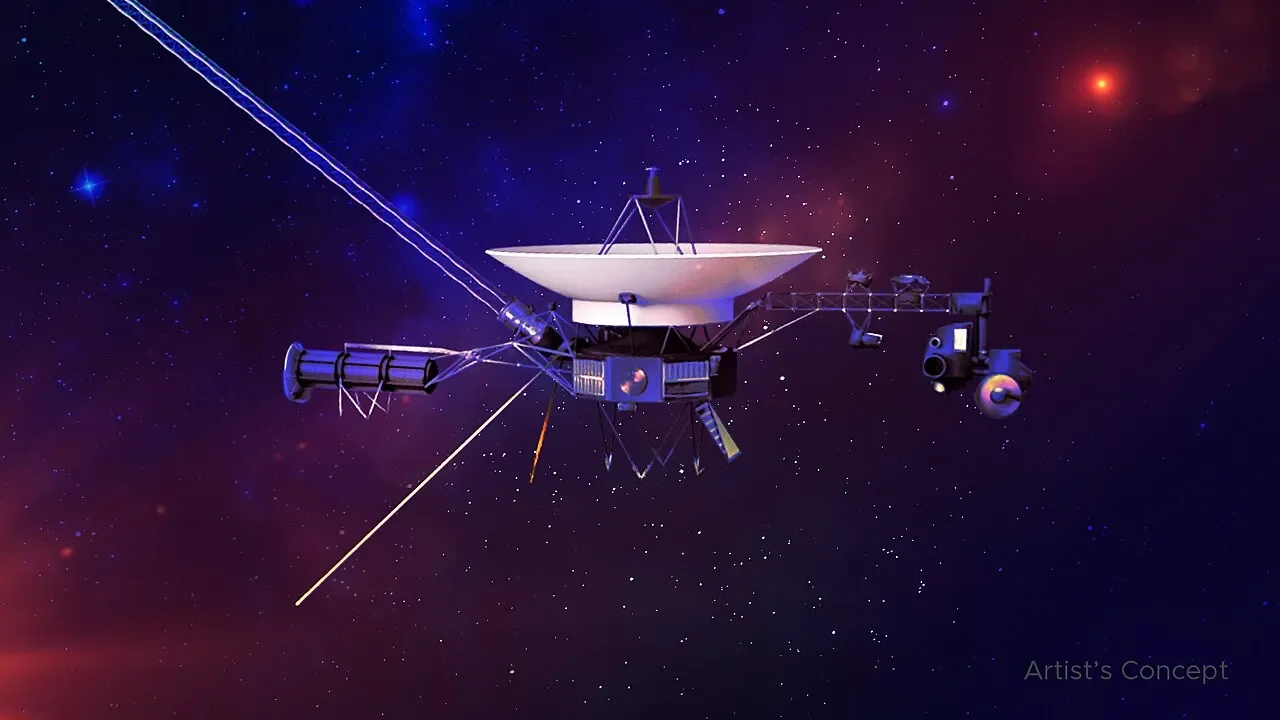
Featured image: an artist’s concept of the Voyager spacecraft, not a photograph of its current location. NASA/JPL-Caltech / Wikimedia Commons; public domain under the NASA image policy. Resized and converted to WebP. Source: https://commons.wikimedia.org/wiki/File:An_artist%E2%80%99s_concept_of_the_Voyager_spacecraft.jpg.


Isiagu Tobby
Wowplus editorial contributor.