




Table of contents
Chuck Berry centenary celebrations reach their milestone on October 18, 2026, one hundred years after the musician was born in St. Louis. The anniversary offers a reason to listen closely to the songs behind the familiar guitar pose. Berry helped make the electric guitar a storyteller, while his records connected everyday ambitions with a sound that could travel far beyond their original audience.
The family-backed CHUCK100 campaign was announced in 2024 as a series leading to this birthday. Its original plans connected tribute recordings and local musicians with Berry’s hometown. Those announcements explain the anniversary’s wider context, although an earlier programme should not be treated as confirmation that every proposed event is taking place today.
The question is what a centenary can reveal beyond an anniversary photograph. As with the distinction between a performer and a public character in our look at Eminem’s career behind Slim Shady, Berry’s image is only a starting point. The records reward attention to phrasing, characters and the relationship between voice and instrument.
How St. Louis shaped the sound
Berry’s official biography traces a musical education that crossed boundaries. Nat King Cole’s vocal clarity and Muddy Waters’ blues were among his influences. In St. Louis clubs, he developed a performing style that could draw from country music as well as rhythm and blues. That mixture matters more than a neat story in which a whole genre suddenly appears through one person.
In 1953, he joined the group associated with pianist Johnnie Johnson. The combination of guitar and piano gave the music movement and conversation. Listening to those exchanges makes the records feel less like monuments and more like working performances: one instrument proposes something, another answers, and the singer keeps the story moving through the middle.

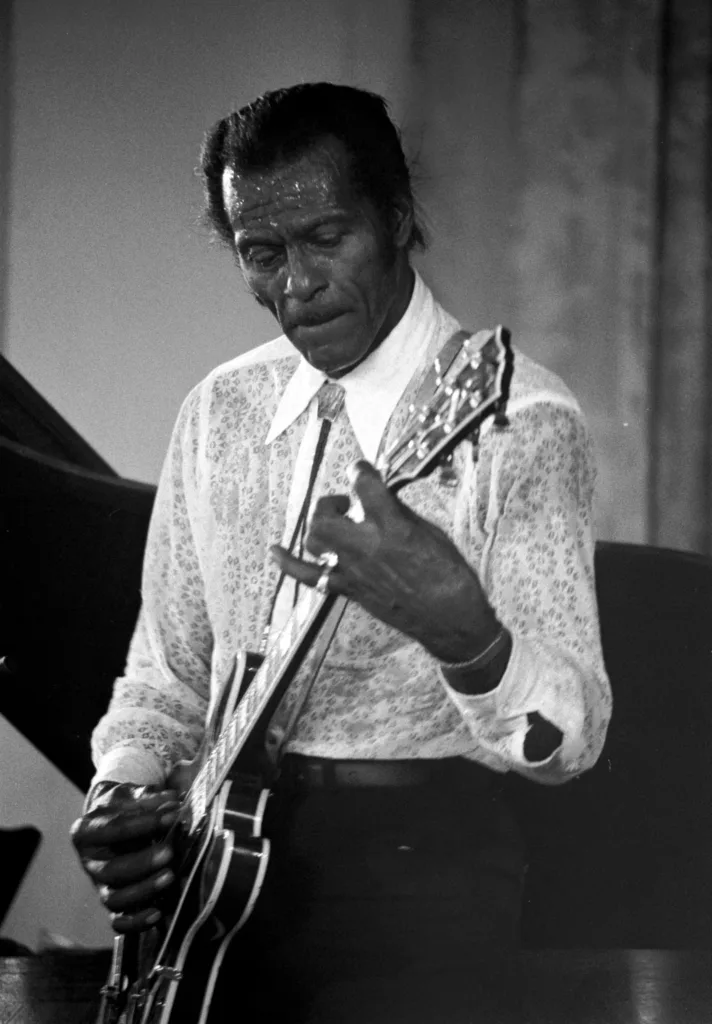
A trip to Chicago brought another important connection. After seeking advice from Muddy Waters, Berry approached Chess Records. His official account describes returning with material that included the song that became Maybellene. Released in 1955, it reached listeners across the pop and rhythm-and-blues charts, opening a much larger stage for a musician whose identity had developed through live work.
That movement from local settings to a wider audience also gives the anniversary a useful community angle. Our report on World Singing Day and shared music-making approached music through participation. Berry’s story is different, but it likewise reminds listeners that the people gathered around a performance help shape what it becomes.
The guitar was part of the storytelling
Maybellene, Roll Over Beethoven and Johnny B. Goode remain useful entry points because they show different parts of Berry’s craft. The guitar introductions establish energy quickly. The words then bring in people, places and desires, rather than leaving the instrument to carry the entire personality of a record. There is wit and movement in the delivery as well as technical invention.
A listener coming to these songs for the first time does not need to begin with a ranking. Play one recording without another task running in the background. Notice when the voice pauses and how the guitar fills the space. Then listen again for the rhythm section. What initially sounds like an instantly recognisable riff becomes a fuller arrangement when the supporting parts receive equal attention.
The Rock & Roll Hall of Fame inducted Berry in its first class in 1986. That recognition gives his career an institutional place in music history, but it should not make the records feel remote. The pleasures are direct: a clear premise, a guitar line that announces itself, and a performance designed to reach people in the room.
Career retrospectives can become narrow when one achievement stands in for everything else. Our profile of Tim Robbins beyond his best-known film explored that problem in acting. For Berry, the same listening habit means moving beyond a single signature introduction and hearing the range within the catalogue.
A song that also travelled into space
There is another reason Johnny B. Goode occupies such an unusual place in popular culture. NASA lists Berry’s recording among the music selected for the Voyager Golden Record. The project placed music alongside other sounds and messages from Earth, giving a familiar rock-and-roll performance a role in a much larger attempt to represent human life.

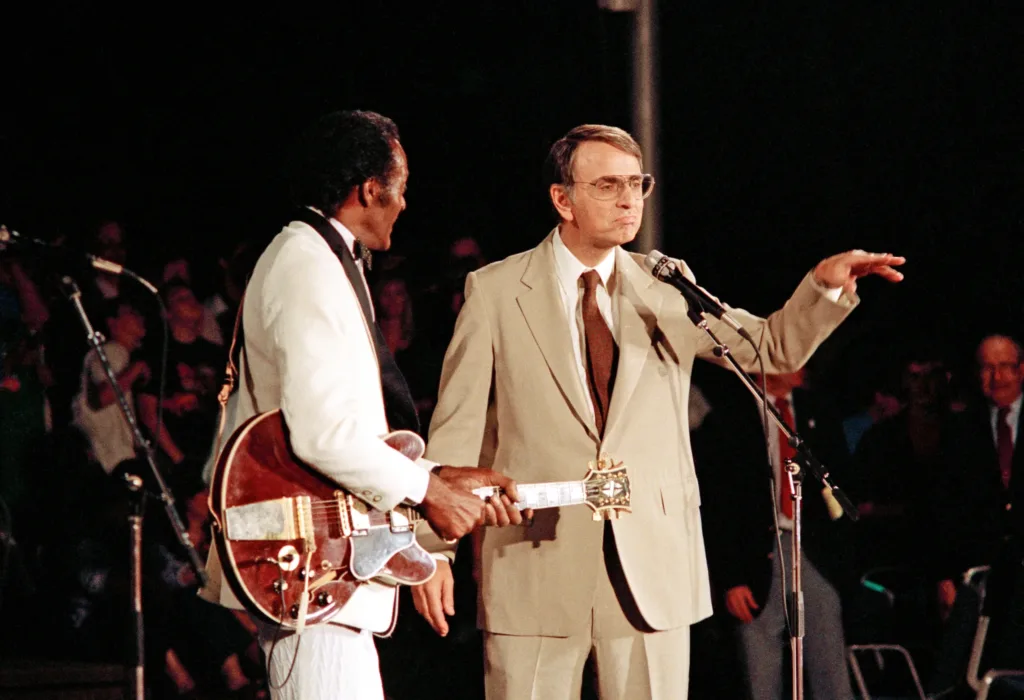
A NASA photograph from August 1989 also places Berry beside Carl Sagan at a Voyager 2 Neptune-flyby celebration. It is a striking pairing, but it should not overshadow the everyday scale of the song. A piece about musical promise could work in a club, on a record player and within a scientific time capsule without losing the personality that made it memorable.
The centenary is therefore an invitation to connect the familiar image with an actual listening experience. Start with the early hits, follow the guitar and piano, and leave room for songs outside the most repeated shortlist. One hundred years after Berry’s birth, the most useful tribute remains available to anyone with a few uninterrupted minutes: hear how the record works, and let the next song change the picture.


Isiagu Tobby
Wowplus editorial contributor.