Table of contents
Tricia Helfer’s next game role gives a familiar voice a different kind of assignment. In the forthcoming fantasy adventure Warlock, she plays Kaatri through full performance capture. For an actor whose game credits include EDI and Sarah Kerrigan, the change brings fresh attention to how a character is made, beyond the recognition attached to her name.
The project was announced by Wizards of the Coast and Invoke Studios in December 2025. The announcement carried by Hasbro identifies Kaatri as a veteran warrior who makes a pact for otherworldly magic. The game’s current official website gives a 2027 release window; the performance remains something audiences will experience in a future release.
Helfer also publicly discussed joining OnlyFans in a May 22, 2026 interview with People, which identified her as 52. She described plans for photographs, videos and livestream Q&As, while retaining control over uploads. Our earlier account of Helfer’s approach to her subscription audience covers that decision. Her work in games offers another, separately documented part of her public career.
How Tricia Helfer’s voice opened another door
Helfer’s association with Battlestar Galactica helped introduce her to game work. In a June 2019 interview with The AU Review, she explained that early opportunities followed recognition of Number Six, with developers interested in her voice. A screen character had become an introduction to a different production environment.
She also described the importance of relationships with voice directors. Those working connections brought opportunities beyond a single science-fiction credit, including animation. The account makes her move into voice work sound less like one dramatic reinvention than a series of professional encounters that gave an established skill new places to develop.
Electronic Arts’ December 2009 cast announcement for Mass Effect 2 identifies Helfer as EDI, the voice of the new Normandy. It lists Seth Green as Joker. Those credits establish the actors behind a pairing that Helfer would later remember fondly when discussing the dialogue between their characters.


EDI and Kerrigan asked for different kinds of work
Speaking to Gamereactor at Comic Con Portugal in 2019, Helfer contrasted two recording experiences. She described the EDI sessions as a relatively streamlined process of delivering individual lines in a booth. Remembering the character included an affection for the exchanges with Joker, rather than merely the technical novelty of playing an artificial intelligence.
Her account of Sarah Kerrigan in StarCraft II emphasized a more collaborative process, including cameras recording her face. She was drawn to the emotional movement through different parts of Kerrigan’s story. The changing character gave the performer something substantial to follow across the work.


These are Helfer’s descriptions of particular productions. Facial reference in an earlier recording session and the full performance capture announced for Warlock should be described in their own terms. The interesting continuity is her attention to the character’s situation, even when the method of recording the performance changes.
A recognizable voice can invite an audience into a fictional world, but recognition only supplies the introduction. A reply still needs a purpose; a relationship still needs changes in tone. Helfer’s recollections point towards those smaller decisions as a useful way to think about the work behind familiar game characters.
That attention to a character’s intentions also runs through our look at Jodie Foster’s forthcoming Disney voice role in Hexed. The productions use different forms of animation and performance, yet both invite audiences to consider the choices beneath a recognizable performer’s voice.
Kaatri brings Helfer into performance capture
On the August 28, 2026 Dragon Con Pre-Game Show, Helfer described Warlock as her first performance-capture project. She distinguished it from her earlier voice work and said further voice-recording sessions remained at that point. Her account describes a production with several stages, rather than a performance completed in one visit.
The official August gameplay announcement gives Kaatri a concrete dramatic relationship: Maggie Robertson plays Tasha, the powerful patron behind her magic. A pact makes the connection part of the story’s premise. For the actors, it also creates a relationship to play across scenes, with each character bringing a different position and purpose.
Helfer’s description of trying a new process is particularly revealing at this stage of her career. Experience gives her previous performances to draw on, while a new recording method introduces another set of demands. The attraction for a reader is that combination of familiarity and an assignment she can still describe as a first.
The audition and the work between scenes
In Variety’s August 25 joint interview with Helfer and Robertson, Helfer said she won the part through auditions. There were two sessions, including an initial Zoom audition lasting about an hour. She initially had only a few scenes, and those scenes changed before filming. The public casting announcement was the endpoint of an earlier process of trying the character.
The same interview describes long dialogue scenes and a collaborative atmosphere. Robertson discussed finding different emotional tones in exchanges that could otherwise seem similar. Helfer credited the head writer with helping her locate scenes within the larger story when filming did not follow its sequence.
That account gives the phrase “playing a warrior” some useful detail. The job includes working out where a conversation belongs, what has already happened and why a response should sound different this time. A strong character design can be an invitation; the actors’ account concerns the work required to give that design changing intentions.
Readers interested in this kind of career perspective may also find a connection in Toni Collette’s movement across screen genres. Looking at contrasting assignments gives a clearer sense of an actor’s working range than treating a familiar face as a single, permanent character.
A 2027 role with a distinct creative question
Helfer’s subscription activity and her game performance belong to different relationships with an audience. In the former, her public explanation concerned the material she chose to share. In Warlock, the available production accounts concern a fictional character created with another actor, writers and a development team. Each can be discussed without assuming one explains the other.
The official release window remains 2027. Before then, the strongest reason to follow Kaatri is the specific change Helfer has described: an experienced game actor working through her first full performance-capture role. Her voice has already become part of several fictional worlds. The next question is how this new collaboration gives that voice a character audiences can follow.
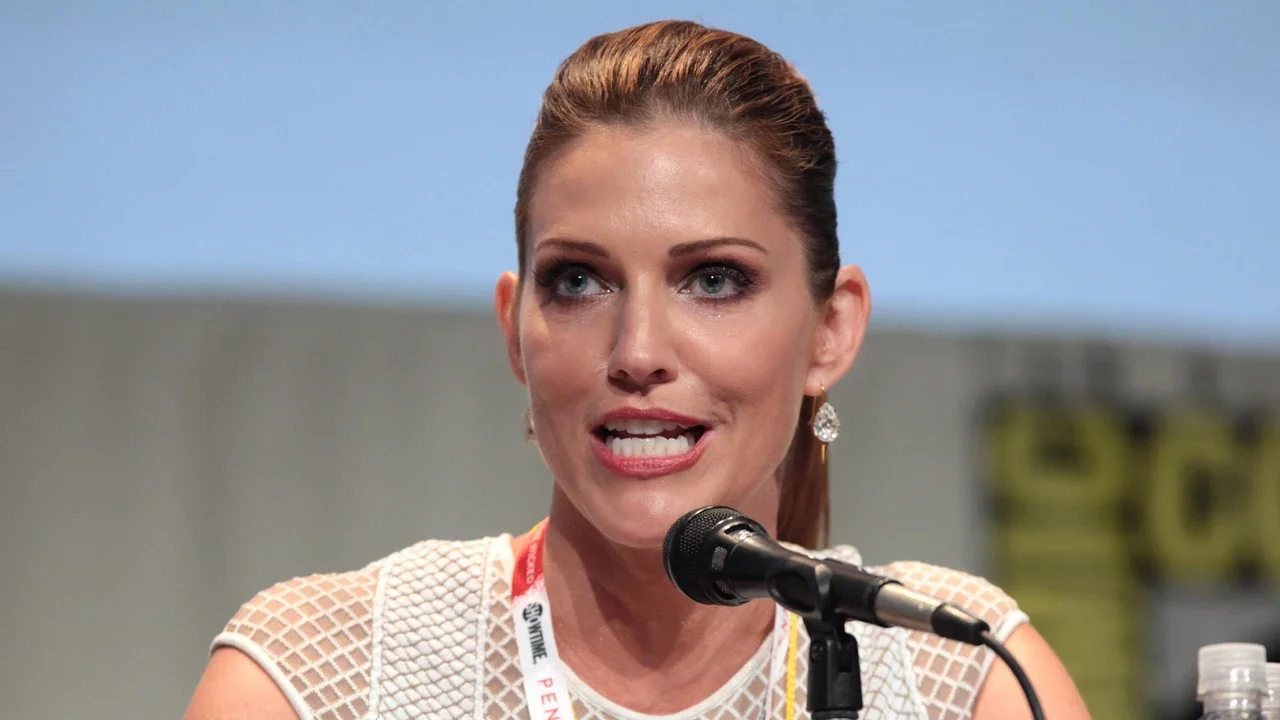
Featured image: archival portrait of Tricia Helfer at the Con Man panel, San Diego Comic-Con, July 9, 2015. Photograph: Gage Skidmore, via Wikimedia Commons, CC BY-SA 2.0. Cropped, resized and converted to WebP; adaptation remains under CC BY-SA 2.0. Source: commons.wikimedia.org/wiki/File:Tricia_Helfer_(19047645963).jpg. License: creativecommons.org/licenses/by-sa/2.0/.


Isiagu Tobby
Wowplus editorial contributor.