Table of contents
Simone Giertz’s photo booth had a customer with a small set of demands. Scraps, her dog, needed a way to get inside, stand where the camera could see her and take a picture without reaching up to a human-sized button. A treat gave her a reason to try the process again. That was enough for Giertz to begin making something viewers could recognize as a photo booth.
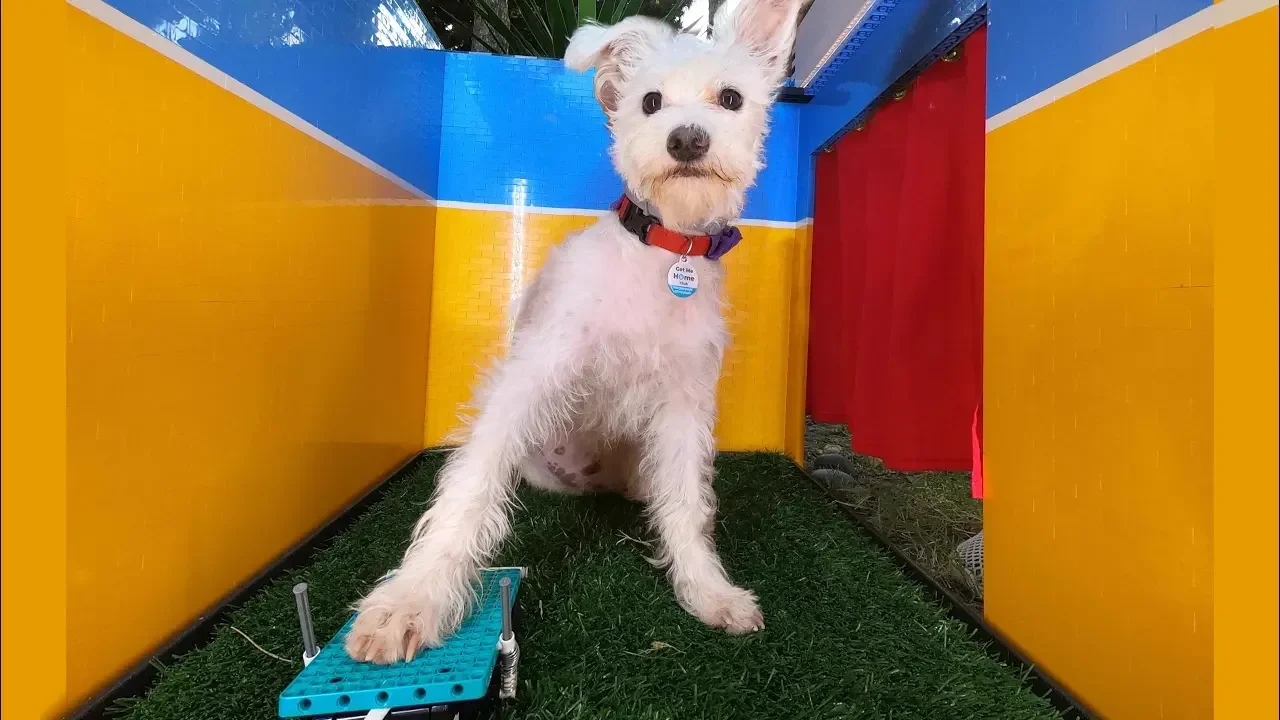
In October 2020, Giertz documented the project on her YouTube channel. Her build used LEGO bricks and a robotics kit, and LEGO described the arrangement in its announcement. A press of a paw triggers a photograph and the booth dispenses a treat. A photograph taken by Scraps shows her looking toward the camera, with one paw still on the blue pedal inside the brightly coloured booth.
Our look at how Giertz later carried her workshop habits into Yetch Studio explored products made for everyday use. The earlier booth is a useful small-scale example of those habits. Working out what Scraps could do was part of the design, just as much as arranging the electronics and giving the structure a recognizable entrance.
Put the button where the dog can reach it
People learn what to do in a photo booth through their own experience of signs, instructions and buttons. Scraps needed a single action that made sense at floor level. The pedal gives the system a clear input, and the position of that input helps bring the dog to the area the camera is set up to photograph.
Watching the demonstration also makes it easier to understand why camera placement matters. A good image depends on where Scraps stands and how high the camera sits. The structure gives her an area in which to move while keeping the camera low enough to record a dog’s view of the booth. One press brings those details together in an image.

The treat adds a second kind of feedback. A person might know that a camera has taken a photo by hearing a shutter or seeing a preview. Scraps gets an outcome that matters to her right away. This makes the sequence legible beyond the human audience watching the finished video. The animal using the booth has a reason to learn how the pedal works.
Why it still looks like a photo booth
The coloured walls and red curtain are part of the project’s humor. Viewers can tell what kind of machine Giertz had in mind before they have watched Scraps use it. The booth’s small scale makes that recognition enjoyable. It is a familiar object rebuilt around a customer who is never going to stand where a person would.
Giertz credited Anna Bresnahan for sewing the curtain and Yvette Solis for helping direct the video. Details like those help make visible the work of presenting a finished build on camera. Casey Neistat’s approach to filming the work around a marathon gives another example of a creator letting audiences see the process that makes a result possible.
For Scraps, a successful session only needs the sequence to work. For a viewer, there is another reward in watching someone figure out how to fit all the pieces together. A familiar object helps the audience follow the effort, while the image at the end makes it possible to tell whether the machine performed the job it was built to do.


What Scraps changed about the design
Giertz returned to her dog as a subject in a 2021 video about making a chair so Scraps could sit close by. That project began with a different observation about how the dog behaves around people. With the chair, the aim was to make room for company. With the booth, it was to give Scraps a physical action she could use to take part.
A small interface can hide a surprising amount of work. The Everyday Unpacked story on how a phone senses a turn explores that idea in another familiar device. A movement that takes a moment to perform sets off a response that an engineer has had to plan for. In Giertz’s booth, what mattered was getting a dog’s step, a camera and a treat to line up at the right moment.
In the video, Giertz identified LEGO as the project sponsor. That context explains why the booth’s brick construction gets so much attention. Viewers can see the materials rather than relying on a description of the finished machine. Giertz’s particular contribution was to give those materials a job: make a recognizable object work for a dog who can reach a pedal and follow the promise of a treat.
The image of Scraps gives those choices a clear result. The dog has her paw where the pedal was placed. Her face is close enough to see, with the curtain and bright walls still in the frame. The person who built the booth chose the conditions for the picture, and Scraps took the step that brought it into being.


Isiagu Tobby
Wowplus editorial contributor.