




















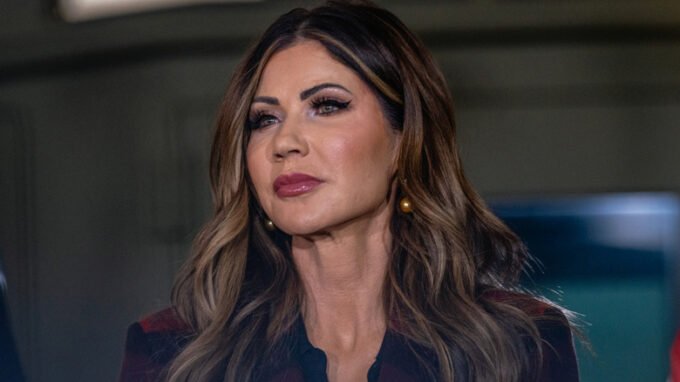

Erika Kirk’s shift from pageant stages to conservative platforms has been fast — maybe too fast for some people’s comfort. She went from running a business and modeling in tiaras to hosting a Christian podcast and stepping into big conservative rooms, filling roles that used to belong to her late husband, Charlie Kirk. That transition has been public, visible, and, not surprisingly, messy in parts. People read a lot into small moments. I do too, sometimes. Maybe that’s unfair, but here we are.
Public grief, public role Erika’s grief has been played out in public, and you can’t separate that from the roles she’s taken on. After Charlie’s death, she stepped forward as the face of Turning Point USA at events and on stages. She’s been interviewed about grief, faith, forgiveness — the whole package. That makes her story compelling; it also opens her up to relentless scrutiny. When someone who’s suddenly very present in a movement smiles a certain way or lingers in a hug, observers notice. They always do.
At the New York Times DealBook Summit on December 3, 2025, Erika was on the main stage answering questions from Andrew Ross Sorkin. She talked about a lot of things: Charlie’s debating style, life after loss, why she forgives the person accused in her husband’s killing. Then came a question about the 2028 presidential field and whether she’d support JD Vance. Her answer was warm — “He’s a dear friend,” she said, noting Charlie had backed Vance in his Senate run. That line — short, personal, but simple — lit up social media. Someone always notices a smile, a tone, a pause. That’s how rumors spread. I saw the clip myself; it’s easy to see why people read into it.
Also read: A Strained Family, a Hospital Bed, and a Quiet Online Response A sudden emergency
Small moments, big interpretations It’s weird how tiny gestures become evidence. A smile, a hug, a compliment — those are normal human things. But in politics, where relationships can mean influence and optics matter, they become much more. On X (née Twitter), people pointed to the way Erika smiled and joked about whether she might replace Usha Vance, the vice president’s wife. Another thread wondered whether Erika might even be a future VP pick. That’s a leap, sure, but gossip rarely stops at reasonable leaps.
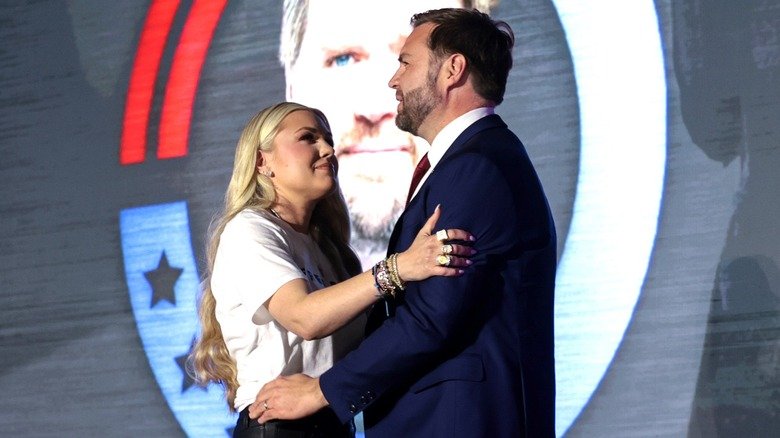
Then there was that onstage embrace at a Turning Point event — “the Hug,” as some called it. It looked affectionate, maybe closer than what some might expect from two public figures who are supposed to maintain a certain distance. Add the speech where Erika said, “No one will ever replace my husband. But I do see some similarities of my husband in JD — in Vice President JD Vance. I do,” and people’s imaginations ran. That line was both tender and oddly comparative, and I admit, it made me pause too.
Tension in the Vance household Another piece of the puzzle: signs of strain in the Vance marriage. Since moving to D.C., JD and Usha Vance have had what people describe as visible tension. In November 2025, JD made a public comment about hoping his wife might one day convert to Christianity. That remark — innocent to some, alarming to others — gave gossip fuel. Religion is deeply personal and can be a source of division; when a spouse voices hopes about conversion in a public forum, it raises eyebrows.

Usha being spotted without her wedding ring didn’t help. Her explanation — she’d been rushed and left it off — didn’t satisfy skeptics. Humans love narratives: a missing ring is a tidy sign in the story of a troubled marriage. Combine that with an ostensibly close friendship between Erika and JD, and tabloids have themselves a headline-generator.
Why people care (and why it matters) This isn’t just petty curiosity. What people worry about, offered in a less charitable light, is influence. If Erika’s influence in conservative circles is growing, who she’s close to matters politically. Would a friendship cross into something more? Would it affect appointments, messaging, who gets promoted inside a movement? That’s why the speculation keeps bouncing between personal gossip and political consequence.
Also read: Dave Coulier has faced health challenges.
On the other hand, I’m aware of a simpler, kinder possibility: two people who share grief, faith, and ideology finding comfort and friendship. I don’t know their private lives. None of us do, really. But when politics, faith, and grief intersect, the consequences are noisy and public.
A few bottom-line thoughts
- Public figures’ private gestures will always be misconstrued. That’s partly their cross to bear.
- Small signs — a smile, a hug, a missing ring — can mean nothing or everything; context is everything, but context is hard to come by.
- The Vances’ marriage tensions and Erika’s rising profile make an easy narrative for gossip. That doesn’t prove anything beyond people’s appetite for stories.
- It’s okay to be skeptical of both the rumor mill and the sanctimony of those who claim the moral high ground. I find myself alternating between cynicism and sympathy, honestly.
In short, Erika Kirk’s visible warmth toward JD Vance, tight hugs onstage, and a certain public chemistry have produced an understandable swirl of gossip — amplified by strained signs in the Vance marriage and the ever-hungry social media commentary machine. Whether there’s anything more than friendship and mutual respect? I don’t have a smoking gun. But these moments make for good watercooler talk, and that’s how political narratives are made, bit by bit.











Leave a comment