The next government’s climate change plan will impact every aspect of Canadians’ lives, public policy researchers say.
Climate change impacts such as wildfires, extreme heat and drought are already affecting Canadians in concrete ways, said Dale Beugin, vice-president of research and analysis at the Canadian Institute of Climate Choices, a non-partisan, publicly funded think-tank. But beyond that, countries worldwide are shifting away from fossil fuels and toward renewable energy to meet targets to cut greenhouse gas emissions and mitigate future damage and costs of climate change.
“How Canada competes in that growing net-zero economy or a low-carbon economy is going to be huge for how well we do in the long term,” Beugin said.
CBC examined the platforms of (in alphabetical order): the Bloc Québécois, Conservatives, Green Party, Liberals and NDP. If a party doesn’t appear in a certain section, there was insufficient information in its platform on that topic, or, in one case, no modelling analysis was publicly available. The People’s Party does not accept the science behind human-caused global warming and simply promises to cancel all climate-related policies and pull out of the Paris Agreement on climate change so it was not included in the analysis.
LISTEN | What do the major parties have to say on climate change?
What On Earth50:08Where the parties stand on climate change
Description: The major parties have made their pledges for climate action. Host Laura Lynch speaks with candidates to discuss their platforms and what it means for Canada’s plan to reduce emissions. 50:08
Here’s how the major parties’ platforms compare in terms of emissions reductions targets, the role of carbon pricing in meeting those targets, what evidence there is that the plans will work, and how the plans aim to transition Canada to a lower-carbon economy to compete in a changing world.

What are the parties’ emissions targets?
Under the 2015 Paris agreement, Canada and 195 other countries have committed to cutting greenhouse gas emissions enough to limit global warming to well below 2 C, and ideally 1.5 C compared to pre-industrial temperatures.
All the federal parties include as a central part of their plan a promise to cut emissions by a certain percentage below 2005 levels by 2030, but to varying degrees:
Bloc Québécois
Conservatives
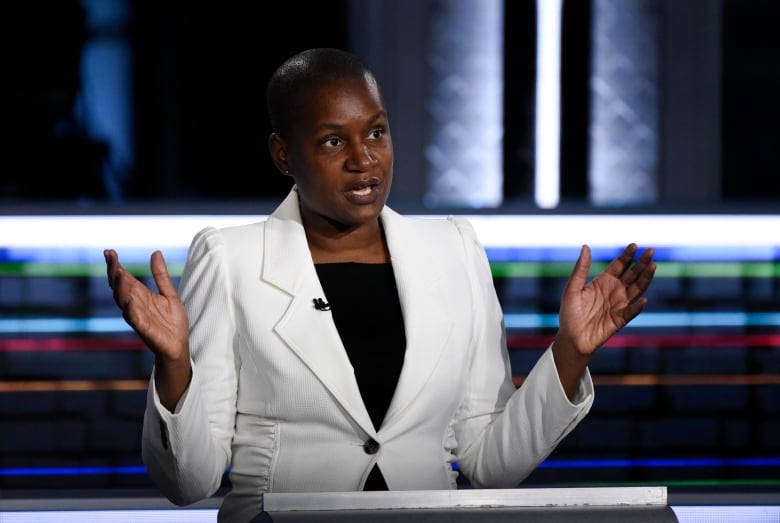
Green Party
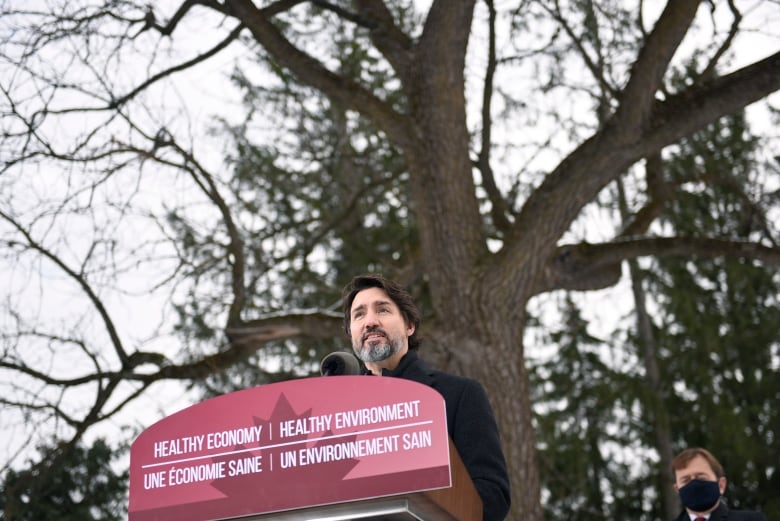
Liberals
- 40 to 45 per cent.
- This would meet the new Paris targets that the current Liberal government has committed to.
NDP
WATCH | The political ambitions behind Canada’s new climate targets

The At Issue panel discusses the political timing and reasoning for Canada’s new emission reduction targets. Plus, the panellists unpack Doug Ford’s pandemic apology and his political future in Ontario. 24:00
How do parties differ on carbon tax or carbon price?
The experts who spoke to CBC said the key to success on emissions reductions is to hit all sectors of the economy.
One broad measure that can do this is carbon taxes or carbon pricing. In general, a higher price drives emissions down more quickly but will cost businesses and individuals more.
All the major parties support carbon pricing in some form. Here are details for each party:
Bloc Québécois
- Doesn’t mention a carbon price in its current platform. In Quebec, where the Bloc’s voter base is located, carbon pricing takes the form of a cap and trade system.
- In 2019, the Bloc supported a tax of $30/tonne, rising to $200/tonne by 2030 but only in provinces with higher-than-average per capita emissions.
Conservatives
- $20/tonne, rising to $50/tonne by 2030 for personal carbon taxes.
- Money raised from the tax will go into a carbon savings account for environmentally friendly purchases, such as a bicycle or a more efficient furnace. Jennifer Winter, an associate professor of economics and scientific director of the energy and environmental policy research division at the University of Calgary’s School of Public Policy, called the latter idea “complex and restrictive” given that carbon taxes are normally a simple system.
- $170/tonne by 2030 for industry but only if the U.S. and Europe match that price. The tax is based on output, meaning companies pay only if they exceed a certain limit. This already the current model for industry.
WATCH | Will the Conservatives’ take on carbon pricing will fly with their voters?

For years, the Conservative Party of Canada railed against the very existence of a carbon tax. Now the party is trying to sell its own take on carbon pricing, but critics aren’t sure it will fly with Conservative voters. 1:46
Green Party
Liberals
- The tax the Liberal government introduced sits at $50/tonne, rising to $170/tonne by 2030 and applies in provinces without their own carbon pricing.
- 90 per cent of personal carbon taxes are returned to consumers via rebates, with the rest going to business, schools, hospitals and municipalities.
- Output-based pricing for industry. Platform says a Liberal government would “continue to put a rising price on pollution.”
NDP
-
Promises to “continue with carbon pricing while making it fairer and rolling back loopholes this Liberal government has given to big polluters,” prompting criticism from experts, such as Winter, about the lack of details.
How do we know parties will meet targets?
Some modelling and analysis has been done by experts to compare some of the plans using similar methodology, estimate whether the plans would achieve their varying targets and, to an extent, compare relative costs.
Conservatives
- The party says its plan has been independently analyzed by Navius Research, which found it would achieve “substantially the same emissions reductions as the government’s current plan in 2030.” (The 2020 plan is expected to reduce emissions 32 per cent below 2005 levels by 2030.)
- However, the plan relies on whether the U.S. and Europe raise their carbon pricing to $170 per tonne by 2030. If they don’t, Canada won’t either and will not meet the 30 per cent target. Tying Canada’s price to other countries “eliminates the price certainty and eliminates any certainty about expected emissions reductions,” said Winter.
- Mark Jaccard, a professor at Simon Fraser University’s school of resource and environmental management, analyzed the Conservative, Liberal, NDP and Green plans all using the same method, including modelling with Navius Research’s gTech model, using a consistent set of assumptions to fill in any gaps. He called the Conservative plan “possibly effective” and “affordable.”
Green Party
- Jaccard’s analysis found the plan “somewhat effective” but very costly. Christopher Ragan, associate professor of public policy at McGill University in Montreal, shared a similar view on CBC’s The Current.
- Kathryn Harrison, a political science professor at the University of British Columbia in Vancouver, said the plan hasn’t been modelled to see if it would achieve its goal, but she thinks a 60 per cent reduction by 2030 would be “extremely difficult for Canada to do.” “In practice, the Greens aren’t going to form government. They know they’re not going to form government, and they are putting issues on the agenda and speaking to a narrower subset of voters,” Harrison said.
- The Climate Action Network has done its own modelling using the same gTech modelling method from Navius Research that Jaccard used and found it’s possible to cut emissions by 60 per cent while growing the economy, but it did not specifically model the Green Party platform.
Liberals
- Environment and Climate Change Canada’s modelling showed the federal government’s plan under the Liberals would be able to cut emissions by 32 per cent below 2005 levels in 2030.
- But Harrison said the party hasn’t provided modelling to show how the new measures proposed in its platform would get Canada to a 40 per cent reduction. “I think it’s debatable whether they have quite enough policy in the window,” said Ragan. Ragan is former chair of the Ecofiscal Commission, which found a carbon price of $200/tonne — higher than the $170/tonne proposed by the Liberals — was needed to get to just a 30 per cent reduction in emissions, well below the Liberals’ current goal of 40 per cent by 2030.
- However, simulations without precise modelling suggest the platform will could achieve the 40 per cent target, said Jaccard.
NDP
- Experts such as Winter have said they found it hard to assess whether the plan would meet its targets because of the lack of detail.
- Harrison noted uncertainties in the NDP’s carbon pricing and regulatory measures but said it looks like its platform relies heavily on regulation of different sectors, which tends to be slow. “I’m very skeptical that the NDP could achieve a 50 per cent reduction,” she told CBC’s Front Burner.
- Jaccard’s analysis, which used a standard set of assumptions to fill in blanks in the parties’ platforms, found the NDP’s plan “largely ineffective” and said implementing it would be “unnecessarily costly” because it relies more heavily on expensive sector-by-sector regulation versus more efficient policies, such as higher carbon pricing.
LISTEN | Mark Jaccard discusses the major parties’ scores on fighting climate change
Radio West7:48Simon Fraser University’s Mark Jaccard discusses the major party’s score on fighting climate change in this election campaign
Simon Fraser University’s Mark Jaccard discusses the major party’s score on fighting climate change in this election campaign 7:48
How do they plan to transition Canada to a low-carbon economy?
As the rest of the world shifts away from fossil fuels, experts anticipate that demand for low-carbon technologies will grow, demand for fossil fuels will decline, and Canada’s economy will need to shift its jobs and production to new industries.
That concept is sometimes called a “just transition,” and the parties’ positions on it differ.
WATCH | A climate expert says Canada needs to get out of the oil and gas business:

Damon Matthews, an expert on climate change planning, says getting out of the oil and gas business is necessary for Canada to reach its Paris accord targets. 4:39
Conservatives
- The Conservatives were the only party that, when answering a survey by environmental groups, didn’t commit to “a rapid phase-out of fossil fuels that supports workers, communities and marginalized groups in the just and fair transition to a sustainable economy.”
- Harrison said it appears the Conservatives, who recently proposed reviving a project to build a new pipeline, “don’t acknowledge that there will be a transition [or] at least that there will be any loss of jobs in the industry.”
Green Party
- Harrison said this plan “really stands apart” in that it’s the only one calling for a broad reduction of fossil fuel production.
- It includes a promise to cancel all new pipeline projects, oil exploration projects, leasing of federal lands for fossil fuel production; ban fracking; ban exports of thermal coal; and phase out bitumen production between 2030 and 2035.
- Would end $7 billion in fossil fuel subsidies, including accelerated capital cost allowance on liquefied natural gas (LNG); tax write-offs for oil and gas wells, coal mining exploration and development; flow-through share deductions for coal, oil and gas projects, and oil and gas properties.
- A Just Transition Act by the end of 2021 that encompasses the needs of workers and communities during transition.
- Promises to replace every “high-paying” fossil fuel sector job with a high-paying green sector job.
Liberals
- $2 billion for a Futures Fund for Alberta, Saskatchewan and N.L. for job creation and a Clean Jobs Training Centre and “just transition” legislation.
- Eliminate oil and gas subsidies by 2023. Winter notes that it doesn’t say which ones and where.
- End thermal coal exports by 2030.
- However, the Liberal government has faced criticism for saying it needs oil pipeline revenues to fund its long-term climate objectives.
NDP
- Promises expanded EI benefits, retraining, job placement services and retirement benefits for workers affected by transition away from fossil fuels and “over a million new good jobs.”
- Would eliminate oil and gas subsidies, ban future subsidies, and redirect money to low-carbon initiatives. It doesn’t say which subsidies but refers to $18 billion. That is the amount that an Environmental Defence report said the federal government spent last year on subsidies and other forms of financial support for the fossil fuel industry, including pandemic wage subsidies and $13 billion in Export Development Canada support for projects such as pipelines.
- Cameron Roberts, a sustainable transportation researcher at Carleton University in Ottawa, wrote in The Conversation that unlike the Conservative and Liberal platforms, the NDP platform would use climate policy to achieve economic and social change and tackle energy demand by prioritizing public transit, walking and cycling.

How else do the climate platforms differ?
All the parties have a climate adaptation component in their platforms that includes disaster response and infrastructure upgrades.
They also all offer support for a cleaner grid, electric cars, green retrofits and “nature-based solutions,” such as restoring wetlands and tree planting for carbon sequestration, although they differ in the details.
Beugin said those types of commercially available and scalable solutions are safe bets and “almost certainly central to any path to net zero.”
LISTEN | Where the major parties stand on climate change
The Current19:54Where major parties stand on climate change
Climate change is set to be a hot topic in the federal election this fall. Guest host Anthony Germain talks to Christopher Ragan, an economist and director of the Max Bell School of Public Policy at McGill University and former chair of the EcoFiscal Commission, and Kathryn Harrison, a political science professor at the University of British Columbia who specializes in climate policy. They discuss what parties are proposing, and what their plans might mean for Canadians. 19:54
The parties differ in the extent to which they rely on regulations in addition to carbon pricing to cut emissions.
Harrison said in general, other regulations can achieve the same goals as carbon pricing if they’re enforced but are more costly for the economy than a higher carbon price.
She suggested that the Conservatives and NDP in particular rely more heavily on regulations as a substitute for higher carbon pricing.
The NDP’s plans include regulations for each sector, which need to be developed and implemented.
“What worries me about that is it’s slow,” she said.

The plans also differ in some of the less-developed technology solutions they support, which Beugin calls “wild cards,” such as carbon capture and hydrogen. Some of those could succeed and pay big dividends, but “there is a need to kind of acknowledge some of that uncertainty and to plan for multiple possible futures,” he said.
Jason MacLean, an assistant professor who studies environmental law at the University of New Brunswick, cautions that investing heavily in them can also be a distraction: “These are very risky bets because if these unproven and expensive technologies don’t pan out, then we won’t have taken the more radical actions to rethink and redesign our economy and our society.”
WATCH | Nationwide rallies call for leaders to act on climate change

Rallies took place in more than 60 communities across Canada to raise the alarm on the urgent need for political leaders to take more action to combat climate change. 1:58
Here are some of the “wild cards” supported by each party:
Bloc Québécois
Conservatives
- A national clean energy strategy that includes production of hydrogen and liquid natural gas.
- $1 billion for hydrogen.
- $5 billion for carbon capture.
- $1 billion for small modular nuclear reactors.
- Renewable gas mandate requiring 15 per cent of natural gas consumed in Canada be renewable, from sources such as food, sewage and landfill waste, by 2030.
Liberals
NDP
-
Research and development and hydrogen fuel cell technology for heavy trucks, freight, marine and aviation.