































Although 5G is still evolving, 6G discussions move closer to standards development, but the debate goes on.
The moment that 3GPP published the first 5G standard (Release 15), discussions started about what 6G should do. Nobody at the time knew how 5G would unfold. We’ve now seen how 5G has changed — or not changed — wireless communications. 6G conferences started in 2020, and since then, the discussions have changed as 5G issues have emerged.
When 6G discussions began, the telecom industry lacked sufficient 5G experience to determine what worked, what didn’t, and how the sector should respond and define 6G. Figure 1 provides a visual representation of 6G discussions.
Also read: Hybrid LoRa-cellular 5G enhances global asset tracking.
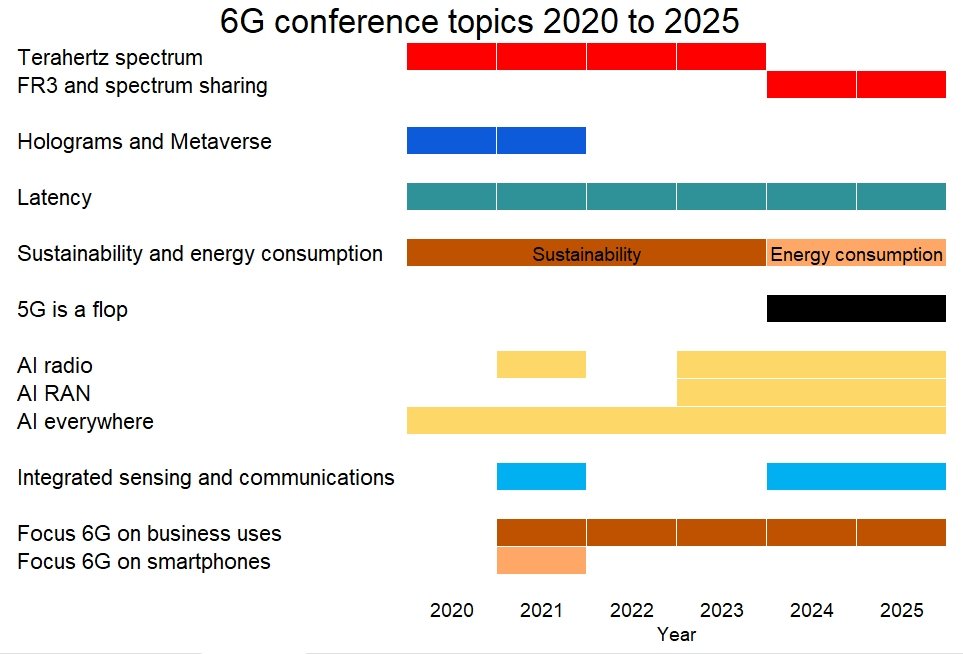
Figure 1. Conversations around 6G have dropped some topics, added some, and changed one.
Conversations at 6G conferences focus on 5G’s shortcomings. With 5G, 3GPP went beyond the usual smartphone applications, adding machine-to-machine communications (M2M) and ultra-reliable low-latency communications (URLLC). Since Release 15, 5G standards have grown to include technologies such as RedCap, designed for IoT applications that don’t need high bandwidth. More recently, satellite communications, non-terrestrial networks (NTN), have gained importance while other topics have faded away.
To create Figure 1, we reviewed our 6G conference coverage and developed a timeline. In 2025, nobody mentioned holographic images or the metaverse. 6G seems to be leaning towards use cases outside of smartphones. Instead, the focus now is on “vertical” applications.
Given the artificial 10-year timeline for releasing a new wireless “G” standard, we’ve now reached the approximate time for 3GPP to begin defining 6G (Figure 2), starting with Release 20. As I see it, we still don’t know enough about 5G implementations to know what to do with 6G. Many People are now questioning the need for a ten-year cycle. The only reason, I believe, for such a cycle is that marketers need something to hype. Unfortunately, they will be disappointed because 6G appears to focus on verticals, not consumers. The only thing everyone agrees on is that AI needs to be everywhere in the network.
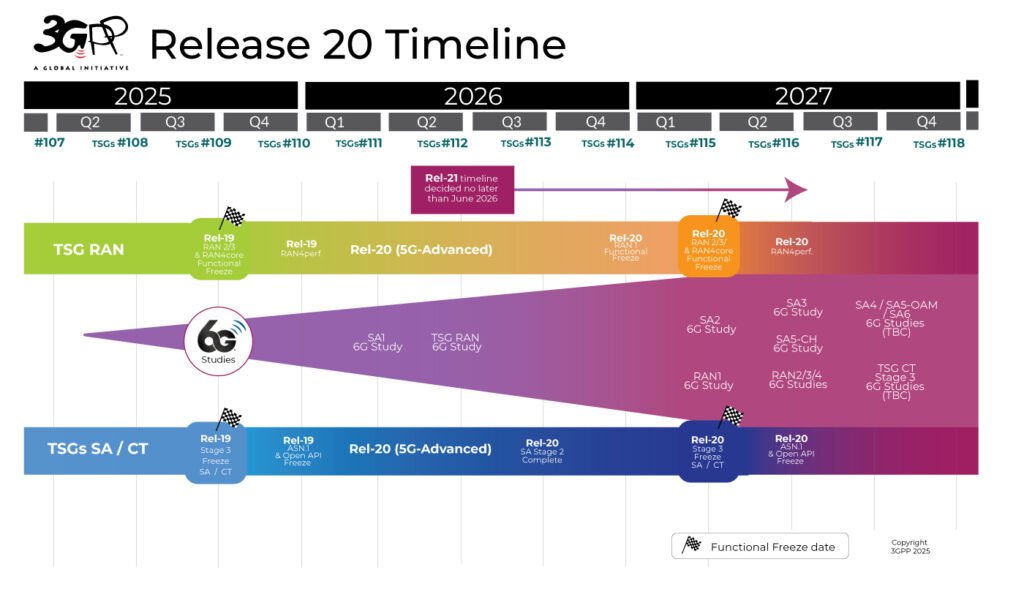
Figure 2. This 3GPP timeline shows that 6G studies should be underway. (Image: 3GPP)
What happened to 5G?
Let’s start with the consumer side, which has received little attention at recent 6G conferences. The initial 5G hype was that it would bring hugely higher data rates to mobile phones, citing the ability to download movies in seconds. For that to happen, a much larger bandwidth was needed. The answer was mmWave frequencies.
Physics and cost got in the way. Physics in that mmWave signals have short ranges and hardly penetrate inside buildings, if at all. To be successful, mmWave needs a small cell on every corner and on every light pole. The cost of deploying so many cells made mmWave economically unfeasible. Today, mmWave gets zero attention at 6G conferences.
Is mmWave dead? Not exactly, but it seems limited to arenas and stadiums where it can reach large numbers of users. Fixed wireless access (FWA) is another place where mmWave is gaining traction, at least in some areas.
Speaking of FWA, that technology was expected to be the first 5G rollout, but the telecom industry wanted mobile first because that’s where the marketers thought the money would come from. They were wrong; consumers refused to pay for 5G because it didn’t deliver speeds much greater than LTE could. The result: FWA deployment was pushed back. Today, the money seems to be in 5G FWA.
Then there’s 5G Standalone (SA) networks. To push telecom operators to adopt 5G, a non-standalone (NSA) version lets them use existing LTE infrastructure for wireless management (the control plane). The data plane could use 5G New Radio (5GNR)without having to wait for a 5G network core to be standardized and deployed. The result: some operators still use 5G NSA. There’s little incentive to upgrade the 5G SA, at least for now. The talk at conferences is not to make that mistake again and have 6G SA be the default. We’ll see how that goes.
Vertical use cases — business, industrial, and IoT — things are starting to gain some traction. The telecom press is just now pushing network slicing and private networks as a way to monetize 5G. Businesses, of course, need to see the advantages, which takes time. In the meantime, many IoT wireless module companies still push LTE as an option in business use cases and IoT designs, especially for devices connecting to 2G and 3G networks, which are shutting down.
In 2025, I heard many conference speakers and people at informal conversations say that the industry needs to learn from 5G’s mistakes. Remember that 5G added technologies for business use cases in addition to smartphone use, which some now say was too much, making 5G too complex.
When people outside the wireless industry ask me about 6G, they naturally refer to smartphones, and by that, they mean higher capacity. Given that mmWave has moved to the outfield, the only way to increase capacity is through more spectrum. That’s where FR3 comes in. FR3 refers to frequencies from 7 GHz to roughly 15 GHz, depending on who you ask. The trouble is that those frequencies are already in use. To make them available for telecom use, we’ll need spectrum sharing. We’ve heard that term before, but it’s still years away from reality, in part because of regulatory implications.
Just as mmWave has dropped out of the conversation, terahertz frequencies have also taken a back seat. Research continues, and the 2025 Brooklyn 6G Summit showcased posters and demonstrations. Terahertz may find some specific use cases, but certainly not in the mainstream.
Instead of focusing on smartphones and even IoT applications, 6G seems to be leaning towards network efficiency, but even that has evolved. In the first few years, we heard much about sustainability. The view then was that sustainability was about saving the world, in part by reducing energy use. People spoke of reducing energy use and waste in the supply chain. Today, 6G talk is about network energy efficiency, which is really about reducing energy costs, not about saving the world.
Also read: New Compact Hybrid Couplers for High-Frequency Wireless Systems
Holograms and the so-called metaverse are gone and forgotten, while integrated sensing and communications (ISAC) has come on strong. I expect that ISAC will become part of a 3GPP 6G specification, though how it will integrate into the radio signal is still up for debate. Exhibits at Brooklyn 6G showed some possible techniques.
Then there’s the radio itself. Some people question the need for a new 6G air interface, citing compatibility with 5G and the cost of deploying all new radios. Qualcomm, however, is already claiming that 6G will bring up to a 50% increase in data rates through a unified air interface. The company claims it has performed simulations to prove that, but simulations of what radio design? In Figure 3, Qualcomm shows 6G air interfaces approaching the Shannon Limit.
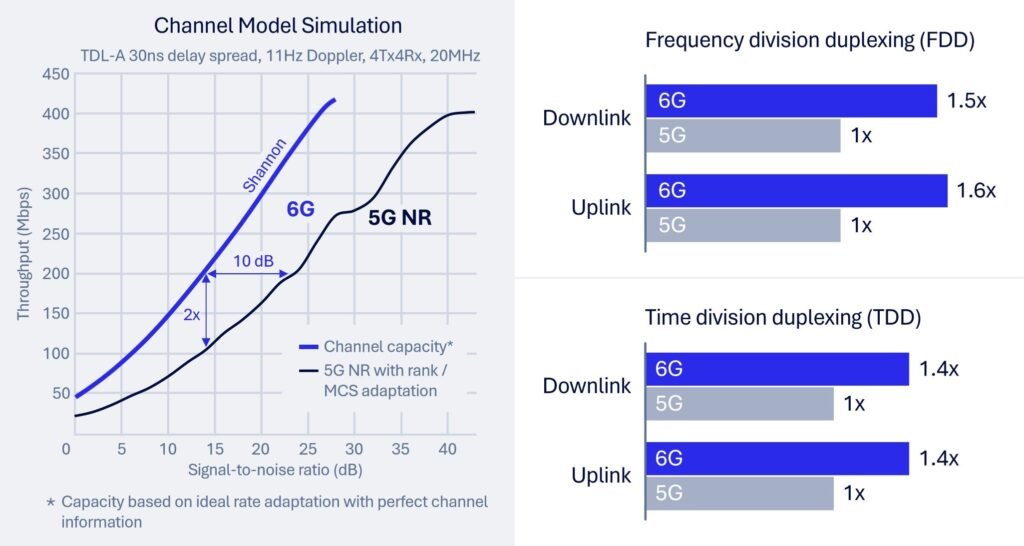
Figure 3. Qualcomm simulations show that 6G radios could approach the Shannon limit. (Image: Qualcomm)
Latency is one such topic that has survived since 2020. 5G was designed to reduce latency for edge computing, moving computing capabilities closer to the user as opposed to having it in the network core. The lower latency of 1 ms was supposed to make a difference. It is, however, no longer fast enough.
What happened? The answer is, of course, people using AI. Look at the timeline in Figure 1. Clearly, AI was a discussion topic before ChatGPT’s release. What’s up with that?
AI everywhere
AI is one topic that has found its way into 6G conversations from the start, even before it became a household term. Researchers were using AI early in this decade to help estimate wireless channel characteristics. Today, the talk is that 6G will have AI everywhere, from the radio to the radio access network (RAN) to the core network.
AI is expected to let 6G radios adapt to their environments. Instead of relying on channel models, AI-based radios will learn how to adjust to their surroundings. By utilizing massive MIMO and AI, base stations can enhance performance, optimize the use of available spectrum, and lower energy consumption.
In the RAN, the AI RAN Alliance claims it will “enhance mobile network efficiency, reduce power consumption, and retrofit existing infrastructure.”
Will 6G need a new core network just as 5G did? I think it’s likely, simply on account of AI. From conversations at conferences, I expect that 6G will not rely on a non-standalone network, even if 5G were to replace 4G for that purpose. The non-standalone network is something nobody wants to repeat in 6G.
Acknowledgement
Thanks to EE World Associate Editor Emma Lutjen for reading all of our previous 6G conference coverage (available below) and compiling the data needed to create the timeline in Figure 1.
Related EE World articles
6G might be closer than we thought
Key takeaways from 6G Symposium
5G, B5G, 6G: A tale of two similar conferences
6G research: consensus grows
6G Symposium emphasizes business and technology
Terahertz research: The road to 6G with Northeastern University
6G: The next generation brings new challenges
Podcast: When will RF engineers start designing 6G radios?
Brooklyn 6G: 5G has more coming before 2030
Brooklyn 6G: Wireless needs to just work
6G: A tale from two conferences
Technical demonstrations round out two 6G conferences
Keysight to begin development of THz technology for 6G
6G promises to bring sustainability to telecom
Experiments bring hope for 6G above 100 GHz
6G Symposium: The discussions continue
6G conference exhibits demonstrate possible technologies
Video: How should 5G, 6G evolve?
6G talk is getting old
6G needs less, 6G needs more
Nokia Bell Labs’ Peter Vetter talks 6G research
Filed Under: 5G, 6G, AI/ML, FAQ, Featured, Sub-6 Ghz RF, Sustainability









Leave a comment