













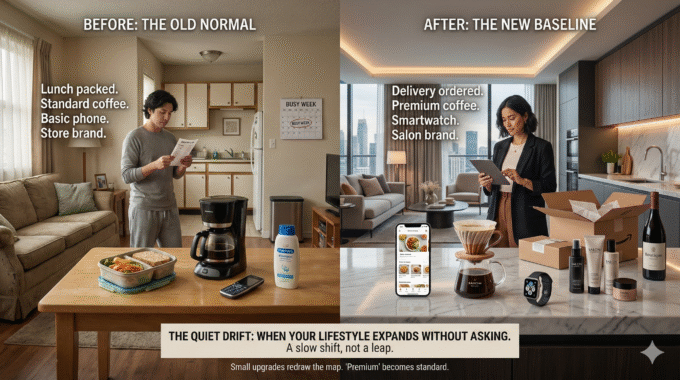











It happens so slowly you might miss it. One month you’re diligently packing lunch. Then, there’s a busy week, and ordering in feels justified. The next week, it happens twice. By the third month, you’re browsing delivery apps without a second thought, and your grocery bill has subtly shrunk to compensate. The line item just… shifted. No big decision was made. That’s the thing about lifestyle inflation—it’s less a leap and more a quiet drift into deeper water.
I think we often imagine it in terms of big, flashy purchases. But in my experience, it’s the small, recurring upgrades that truly anchor the change. The pharmacy shampoo swapped for a salon brand. The standard subscription tier bumped to “premium.” The grocery store wine section you now breeze past for the dedicated bottle shop. Each step feels minor, a small treat for your hard work. But collectively, they redraw the map of your normal spending, and suddenly you need that higher salary just to maintain this new, slightly shinier baseline.
Also read: The Invisible Pressure: How “Keeping Up With The Joneses” Sabotages Adult Wealth
The “Why” Behind the Spend
Often, it’s not really about the thing itself. It’s about a story we’re telling ourselves, or a feeling we’re trying to capture. That new outfit isn’t just fabric; it’s “the kind of person who has this together.” The fancier dinner out is “finally enjoying the fruits of my labor.” The spending becomes symbolic. The trouble is, the feeling is fleeting—the credit card charge is not. We’re chasing a vibe, but buying a product.
And there’s a social momentum to it, too. As your peers or colleagues level up their lives, it becomes strangely disorienting to opt out. Saying “no” to things starts to feel like you’re falling behind, even if your bank account is perfectly healthy. You’re not just managing money; you’re managing a sense of identity and belonging, which is infinitely trickier.
Catching the Drift: Noticing Without Judgement
The first, most powerful step is simply to notice. Not to judge or berate yourself, but to observe with mild curiosity. Look at your spending from two years ago. I did this recently and had a genuine laugh—my “entertainment” category was half what it is now. What changed? Did my joy double? Not really. My habits just… evolved.
Try this: for one non-essential purchase this week, pause and ask, “Is this my old normal, or my new one?” There’s no right answer. The goal is just to introduce a moment of awareness, a flicker of consciousness before the autopilot spending kicks in.
A Counterintuitive Fix: The “One Down” Rule
Most advice tells you to cut back. That feels like deprivation. Instead, try going “one down” intentionally, just to prove you can. If you usually get the large coffee, get a medium. If you automatically book the “premium” rental car, choose the standard. It’s a small experiment to remind your brain that the cheaper option is still perfectly functional—and often, exactly the same experience. It breaks the assumption that more expensive is automatically better. You reclaim the feeling of choice.
Also read: 🧠 The Debt Snowball vs. The Avalanche: Why Logic Loses to Feelings
Money for Something, Not for Everything
This was a game-changer for me. Give every dollar of new income a job before it arrives, and make sure one of those jobs is “fun.” If you get a $100 monthly raise, maybe $50 goes to retirement, $30 goes to a “wish list” savings fund, and $20 is officially, guiltlessly, for whatever you want. This way, you’re building your future and allowing for some inflation in a controlled way. You’re admitting that yes, you want to enjoy some of this, and that’s okay. It just doesn’t get to soak into every corner of your budget.
Aslo read: 💰 Beyond the Toy Aisle: How Early Ads Lead to Adult Financial Habits
The Freedom of a Lower “Need”
Here’s the subtle shift in perspective that helped me. The ultimate goal isn’t to afford everything you want. It’s to lower the threshold of what you need to feel content. It’s the difference between racing to earn enough for a lavish life, and cultivating a life where your needs are modest enough that your earnings create surplus, security, and options. That surplus is freedom. It’s the ability to take a risk, to say no to a bad job, to breathe easily.
Lifestyle inflation isn’t a moral failing. It’s a natural tendency. The trick is to replace the quiet drift with intentional navigation. To occasionally choose the smaller coffee, not because you have to, but because you want to remember that you can. Because the real luxury isn’t in the upgrade itself, but in knowing you’re the one actually in charge of the map.










Leave a comment