




























Wi-Fi 7 In a video interview, Wi-Fi test veteran Fanny Mlinarsky updates us on Wi-Fi 7’s new features and how they work.
With Wi-Fi 6 and 6E products now available, the industry moves to Wi-Fi 7. While the 802.11be standard is still in development, chipsets have begun rolling out of fabs and onto boards. “Plugfests have already begun,” said Fanny Mlinarsky in a video interview with EE World.
Mlinarsky has worked on Wi-Fi since 2001. She founded Azimuth Systems and Octoscope, the former acquired by Anritsu in 2016 and the latter acquired by Spirent in 2021. The interview took place on December 20, 2022. Soon after, Mlinarsky left Spirent as part of the acquisition agreement.
Also reaD: Varistors Protect Automotive Ethernet From Overvoltage Conditions
Wi-Fi 7 includes several enhancements to boost data throughput as high as 43 Gb/sec, exceeding those of 10 Gb/sec Ethernet. For example, it widens channel bandwidth from 160 MHz to 320 MHz. To further increase data rates, Wi-Fi 7 uses 4096QAM instead of 1024QAM, which Mlinarsky describes as “scary.”
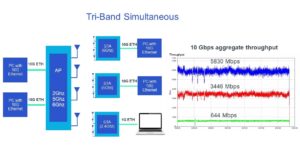
Wi-Fi 7 can operate across all three allocated frequency bands.
In the video, Mlinarsky discusses how Wi-Fi 7 works in a mesh network. That is, it can use multiple internet access points instead of a single point, called multilink operation (MLO). Through a mesh network, Wi-Fi 7 sets up front-haul and backhaul link to move data across the network to an internet access point. MLO can operate across different frequency bands (2.5 GHz, 5 GHz, 6 GHz), not just different channels in the same band. This feature, called Enhanced Multilink Single-Radio (EMLSR), lets Wi-Fi 7 make more efficient use of the available spectrum. Unfortunately, using multiple frequency bands for front-haul and backhaul functions makes for new management and arbitration issues, which Mlinarsky explains.
Are you designing products with Wi-Fi 6 or 6E with an eye towards Wi-Fi 7? What are your experiences with design and testing?













Leave a comment