



The lumbar spine, or low back, is a remarkably well-engineered structure of interconnecting bones, joints, nerves, ligaments, and muscles all working together to provide support, strength, and flexibility. However, this complex structure also leaves the low back susceptible to injury and pain.

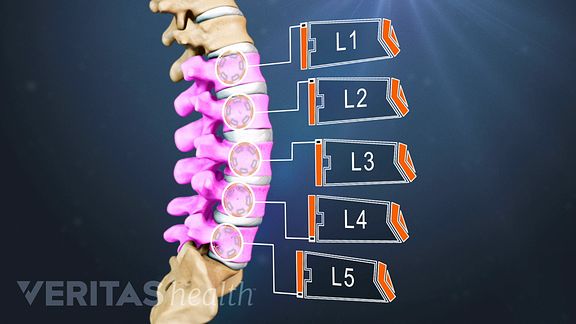
Injury to any of the structures in the lumbar spine can lead to low back pain.
Watch: Lumbar Spine Anatomy Video
To help understand this complicated topic, this article presents a model for understanding symptoms, physical findings, imaging studies and injection techniques to come to a precise diagnosis.
See Getting an Accurate Back Pain Diagnosis
Once an accurate diagnosis of the cause of the lower back pain is attained, treatment options can be selected based on today’s best medical practices.
See Conservative vs Surgical Care for Lower Back Pain
The Lumbar Spine, What Can Go Wrong
The low back supports the weight of the upper body and provides mobility for everyday motions such as bending and twisting. Muscles in the low back are responsible for flexing and rotating the hips while walking, as well as supporting the spinal column. Nerves in the low back supply sensation and power the muscles in the pelvis, legs, and feet.
See Back Muscles and Low Back Pain
Most acute low back pain results from injury to the muscles, ligaments, joints, or discs. The body also reacts to injury by mobilizing an inflammatory healing response. While inflammation sounds minor, it can cause severe pain.
There is a significant overlap of nerve supply to many of the discs, muscles, ligaments, and other spinal structures, and it can be difficult for the brain to accurately sense which is the cause of the pain. For example, a degenerated or torn lumbar disc can feel the same as a pulled muscle – both creating inflammation and painful muscle spasm in the same area. Muscles and ligaments heal rapidly, while a torn disc may or may not. The time course of pain helps determine the cause.
See Pulled Back Muscle and Lower Back Strain
In This Article:
- Lower Back Pain Symptoms, Diagnosis, and Treatment
- Causes of Lower Back Pain
- Lower Back Pain Symptoms
- Diagnosing Lower Back Pain
- Early Treatments for Lower Back Pain
- Non-Surgical Treatments for Lower Back Pain
- Surgery for Lower Back Pain
- Causes of Lower Back Pain Video
Range of Lower Back Pain Symptoms
Low back pain can incorporate a wide variety of symptoms. It can be mild and merely annoying or it can be severe and debilitating. Low back pain may start suddenly, or it could start slowly—possibly coming and going—and gradually get worse over time.
See Low Back Pain with Referred Pain
Depending on the underlying cause of the pain, symptoms can be experienced in a variety of ways. For example:
- Pain that is dull or achy, contained to the low back
- Stinging, burning pain that moves from the low back to the backs of the thighs, sometimes into the lower legs or feet; can include numbness or tingling (sciatica)
- Muscle spasms and tightness in the low back, pelvis, and hips
- Pain that worsens after prolonged sitting or standing
- Difficulty standing up straight, walking, or going from standing to sitting
Watch Video: What Is Your Back Muscle Spasm Telling You?
In addition, symptoms of lower back pain are usually described by type of onset and duration:
-
- Acute pain. This type of pain typically comes on suddenly and lasts for a few days or weeks, and is considered a normal response of the body to injury or tissue damage. The pain gradually subsides as the body heals.
See Types of Back Pain: Acute Pain, Chronic Pain, and Neuropathic Pain
-
- Subacute low back pain. Lasting between 6 weeks and 3 months, this type of pain is usually mechanical in nature (such as a muscle strain or joint pain) but is prolonged. At this point, a medical workup may be considered, and is advisable if the pain is severe and limits one’s ability to participate in activities of daily living, sleeping, and working.
- Chronic back pain. Usually defined as lower back pain that lasts over 3 months, this type of pain is usually severe, does not respond to initial treatments, and requires a thorough medical workup to determine the exact source of the pain.1
See Chronic Pain As a Disease: Why Does It Still Hurt?
Types of Low Back Pain
There are many ways to categorize low back pain – two common types include:
-
- Mechanical pain. By far the most common cause of lower back pain, mechanical pain (axial pain) is pain primarily from the muscles, ligaments, joints (facet joints, sacroiliac joints), or bones in and around the spine. This type of pain tends to be localized to the lower back, buttocks, and sometimes the top of the legs. It is usually influenced by loading the spine and may feel different based on motion (forward/backward/twisting), activity, standing, sitting, or resting.
See Axial Back Pain: Most Common Low Back Pain
-
- Radicular pain. This type of pain can occur if a spinal nerve root becomes impinged or inflamed. Radicular pain may follow a nerve root pattern or dermatome down into the buttock and/or leg. Its specific sensation is sharp, electric, burning-type pain and can be associated with numbness or weakness (sciatica). It is typically felt on only one side of the body.
See Radiculopathy, Radiculitis and Radicular Pain
There are many additional sources of pain, including claudication pain (from stenosis) myelopathic pain, neuropathic pain, deformity, tumors, infections, pain from inflammatory conditions (such as rheumatoid arthritis or ankylosing spondylitis), and pain that originates from another part of the body and presents in the lower back (such as kidney stones, or ulcerative colitis).
It is also possible for low back pain to develop with no definitive cause. When this happens, the primary focus is on treating the symptoms (rather than the cause of the symptoms) and the patient’s overall health.
See All About Neuropathy And Chronic Back Pain
For subacute and chronic lower back pain, a thorough diagnosis is important to lay the foundation for appropriate treatment and rehabilitation. Lower back pain treatment reduces the likelihood of recurrent back pain flare-ups and helps prevent the development of chronic lower back pain.